While you focus on patient care, know that Medmax handles your complicated operational and analytical tasks. Our full range of services lets you take a sigh of relief!
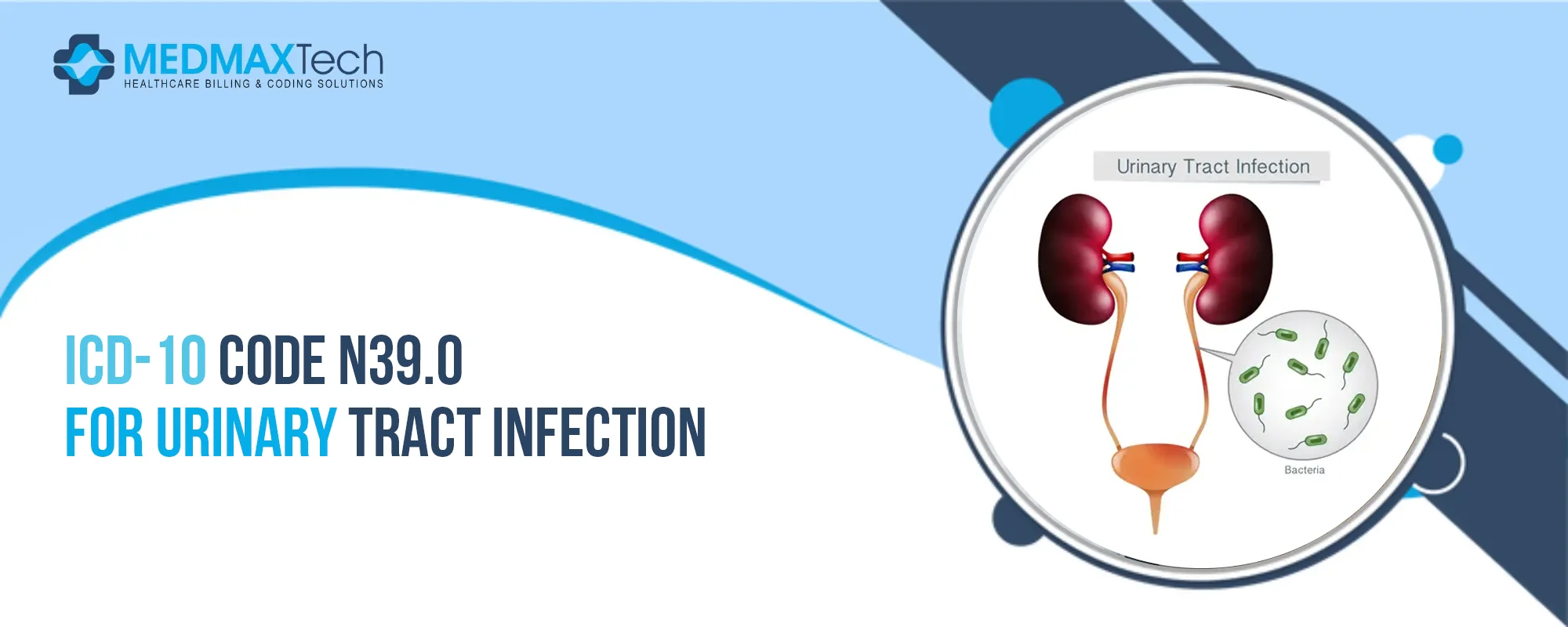
ICD-10 Code N39.0 for Urinary Tract Infection (UTI)
The N39.0 code continues to be the main code used for unspecified urinary tract infections. But the 2025 update brings important changes that affect documentation and code selection. Key updates include new hypoglycemia classifications linked to UTI complications and clearer rules for coding acute and chronic infections.
For UTIs during pregnancy, O23.0 must be used along with the required trimester detail. Code Z87.440 documents a patient’s personal history of UTIs, which is important for preventive care planning. When lab tests confirm certain organisms, extra codes are needed—such as B96.2 for Escherichia coli (E. coli).
Healthcare providers must understand these new coding rules to ensure accurate reimbursement. These updates support more standardized classifications based on current medical knowledge. Specific codes help identify the exact infection source, leading to better treatment decisions.
What is UTI ICD-10 N39.0 Code?
N39.0 is the ICD-10 classification code for urinary tract infections when the exact location in the urinary system is not mentioned. This billable diagnostic code remains in the official 2025 ICD-10-CM manual effective October 1, 2024. The uti code is used for general UTI cases where providers document the infection but do not specify the exact site in the genitourinary tract. Choosing the correct N39.0 code affects claim approvals and reimbursement. While this uti code offers flexibility, its unspecified nature may lead payers to request more details.
Providers must understand when N39.0 should be used. The code is valid when documentation proves an infection exists but does not identify its exact location. However, it should not replace more specific codes when details about bladder infection, kidney infection, or other sites are available.
This code is especially relevant for:
Initial UTI cases while lab results are pending
Generalized infections affecting multiple urinary areas
Cases where the infection site cannot be identified N39.0 helps standardize reporting while supporting proper treatment and documentation requirements.
What conditions does N39.0 cover?
N39.0 includes general urinary infections without clear anatomical location. This uti code may be used for infections affecting the bladder, urethra, or ureters when the exact site is not documented. It applies to several clinical conditions such as:
Acute upper or lower urinary tract infections
Bacterial infections with confirmed bacteriuria
Chronic urinary tract infections
Febrile UTIs with systemic symptoms
Recurrent urinary tract infections
Catheter-associated UTIs
ICD-10-CM rules require adding organism-specific codes when lab tests identify bacteria. Codes from B95-B97 must be used to document organisms like E. coli, Klebsiella, Enterococcus, or Pseudomonas. As the guidelines state, “The importance of consistent, complete documentation in the medical record cannot be overemphasized.”
When Should You Use UTI ICD N39.0 Instead of a More Specific Code?
Use N39.0 only in specific situations, such as:
UTIs without a documented anatomical site
Lab-confirmed infections with no specified location
General urinary symptoms with positive cultures
Coders must also be aware of major Excludes1 rules that prevent using N39.0 with certain conditions, including:
Urinary tract candidiasis (B37.4-)
Neonatal UTI (P39.3)
Pyuria (R82.81)
Site-specific UTIs such as cystitis (N30.-), pyonephrosis (N13.6), or urethritis (N34.-)
CDC reports that incorrect code combinations cause claim delays. Coding expert Jill Young states, “Most cases often code back to N39.0” unless the patient is pregnant or a newborn. But using unspecified codes can increase reimbursement risk.
Starting October 1, 2024, Medicare and commercial payers implemented stricter Excludes1 claim checks. Even minor errors can cause automatic denials. Missing site specificity often forces providers to use N39.0, but it also increases the chance of claim rejection.
What Changed for N39.0 in the 2025 ICD-10-CM Update?
The 2025 ICD-10-CM update introduces an important new exclusion rule for N39.0. This change clarifies when providers must use a more specific UTI code.
New Excludes1 Note: Major Change
As of October 1, 2024, a mandatory Excludes1 note appears under N39.0. It states that specific UTI types cannot be coded together with N39.0. These include:
Cystitis (N30.-)
Pyonephrosis (N13.6)
Urethritis (N34.-)
These diagnoses are mutually exclusive with N39.0 and cannot appear on the same claim.
What is the New Excludes1 Note Under N39.0?
Since August 31, 2024, Medicare and commercial payers have increased Excludes1 claim audits for N39.0. The new rule prohibits using N39.0 when documentation specifies the infection site. Instead, these codes must be used:
N30.- for bladder infections
N13.6 for kidney infections with pus
N34.- for urethral infections
Coding expert Jessica Thompson, CPC, states: “Per the Excludes1 note, some UTIs are classified elsewhere.” Even small violations can cause auto-denials and require resubmission.
How Does the 2025 Update Impact Coding Practices?
This small change has a major effect on UTI coding. According to CDC data, Excludes1 errors affect about 12% of UTI claims nationwide. The update brings three major requirements:
Clearer documentation that identifies the infection site or states “site unspecified”
Careful review of clinical notes for any anatomical details
Higher claim denial risk when N39.0 is used incorrectly
The ICD-10-CM guidelines remind providers: “Accurate coding cannot be achieved without complete documentation.” For non-pregnant patients with no specified infection site, N39.0 is still correct. However, pregnant patients must always be coded with O23.4-.
Impact on Documentation and Claim Processing
This update changes how providers must document UTIs. Now they must:
Document any site-specific information
Review notes carefully before selecting codes
Prevent denials due to wrong code combinations
The ICD-10 instructions take priority over all guidelines, meaning the new Excludes1 note directly controls how N39.0 is assigned. For pregnant patients, O23.4- codes remain required regardless of site documentation.
How to Apply the 2025 Updates When Coding UTIs
The updated Excludes1 note requires careful review and accurate code use to avoid denials.
Correct Use of N39.0 After the Update
Use N39.0 only when documentation confirms a UTI with no identified location. Examples include:
Lab-confirmed infection without site detail
Notes stating “generalized UTI”
“UTI, organism pending” without anatomical detail
When lab tests identify an organism, add the correct organism code. Example: N39.0 + B96.2 for E. coli.
Coding specialist Jessica Thompson explains that many facilities used to default to N39.0, but this is no longer allowed when site details are available. As healthcare moves toward more precise coding, N39.0’s unspecified nature raises reimbursement risks. Always review documentation before selecting the code.
What are common mistakes to avoid with UTI coding in 2025?
Excludes1 errors make up nearly 40% of UTI claim denials. The 2025 updates require stricter documentation and careful code selection.
Can you still use N39.0 for recurrent UTIs?
Yes, N39.0 can still be used for recurrent UTIs, but only if the documentation does not identify a specific site. Documenting “recurrent” alone is not enough. Thorough documentation must include:
Whether the infection is a reinfection or relapse
Confirmation that the previous infection resolved
Risk factors such as structural issues or resistant bacteria
According to CDC data, 20–30% of women experience recurrent UTIs, showing the importance of accurate documentation.
What happens if you ignore the Excludes1 note?
Since August 31, 2024, Excludes1 reviews are much stricter. Ignoring the rule leads to:
Immediate claim rejection
Inaccurate patient records
Increased audit risk
Treatment errors
Cystitis, urethritis, and similar infections already specify the site, making N39.0 unnecessary and incorrect. Common denial causes include:
Missing site details
Coding N39.0 with N30
Incorrect pregnancy-related UTI coding
Conclusion: N39.0 Coding Guidance for 2025
The 2025 updates to N39.0 require major documentation changes for healthcare professionals. The new Excludes1 note clearly separates site-unspecified UTIs from site-specific ones. CDC data shows coding errors frequently lead to denials, so documentation must be updated immediately. N39.0 can no longer be used as a default general code. Key documentation rules:
Record specific infection sites when known
Use N30.-, N13.6, or N34.- for site-specific cases
Use O23.4- for pregnant patients and P39.3 for neonates
Add organism codes (B95-B97) when identified
Following these guidelines improves claim approvals and supports accurate patient care.
FAQs
What is the ICD-10 code N39.0 used for?
It is used for urinary tract infections when the exact location is not documented.
How does the 2025 update affect N39.0?
It adds an Excludes1 rule preventing its use when a specific site is documented.
When should N39.0 be used after the update?
Only when a confirmed UTI has no documented anatomical location.
What common mistakes should be avoided?
Using N39.0 with excluded codes, using it when a site is documented, or not reviewing notes for specificity.
Are there special considerations for recurrent UTIs?
Yes. Proper documentation must include details about past infections, resolution, and risk factors.
Jessica CollinsCertified Professional Coder
Jessica Collins is a Certified Professional Coder (CPC) specializing in medical billing services and revenue cycle management (RCM). She works closely with healthcare providers and medical billing companies to streamline claim processing, reduce denials, and enhance reimbursement efficiency.
Jessica Collins is a Certified Professional Coder (CPC) specializing in medical billing services and revenue cycle management (RCM). She works closely with healthcare providers and medical billing companies to streamline claim processing, reduce denials, and enhance reimbursement efficiency.