





ICD-10 Code For Low Back Pain
Low back pain affects a large number of patients. But how common is it really? According to the World Health Organization (WHO), about 619 million people worldwide had low back pain in 2020, making it the most common musculoskeletal condition in the world. Even more concerning, the WHO estimates that by 2050, the number of people with low back pain will increase to 843 million as the global population continues to age.
Because of this growing trend, rehab therapists can expect to treat even more low back pain patients in their physical therapy clinics in the coming years. This makes it important for therapists to stay updated—not only on how to treat low back pain, but also on how to choose the correct ICD-10 codes. But which diagnosis code should you use, and when is it better to code low back pain instead of sciatica? We’re here to explain and make selecting an ICD-10 code for low back pain as simple and stress-free as possible.
What are the different types of low back pain?
Patients may only be able to say that their lower back hurts and explain how long the pain has lasted. However, clinicians know that low back pain generally falls into three categories, according to the National Institute of Arthritis and Musculoskeletal and Skin Diseases (NIAMS):
- Acute low back pain
- Subacute low back pain
- Chronic low back pain
NIAMS also explains that chronic low back pain can have several causes, including:
- Mechanical or structural issues such as strains, sprains, or degenerated or ruptured discs
- Inflammatory conditions like ankylosing spondylitis
- Other conditions such as osteoporosis, infections, or back pain during pregnancy
What’s the ICD-10 code for low back pain?
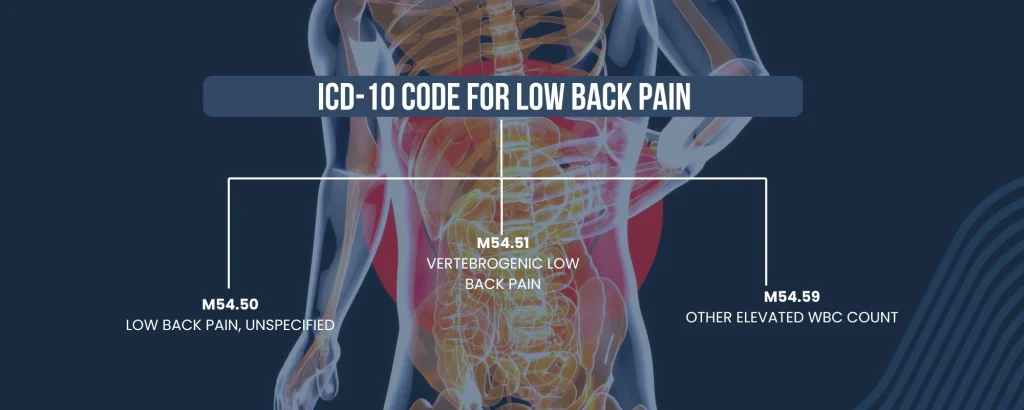
The way low back pain is coded has changed in recent years. In the past, therapists commonly used ICD-10 code M54.5 for low back pain. However, CMS eliminated this code in the 2022 final rule. Since M54.5 was widely used by rehab therapists, CMS introduced new, more specific ICD-10 codes to replace it.
The three new ICD-10 codes that replaced M54.5 are:
- M54.50 – Low back pain, unspecified
- M54.51 – Vertebrogenic low back pain
- M54.59 – Other low back pain
Today, therapists should use one of these newer ICD-10 codes for low back pain instead of M54.5.
When is coding M54.50 appropriate?
As always, accurate coding depends on using the most specific diagnosis available. ICD-10 code M54.50 is used for unspecified low back pain. This code also includes loin pain and lumbago with non-organic signs and symptoms (NOS). However, if a more specific ICD-10 code applies to the patient’s condition, that code should be used instead.
Are there any Excludes1 edits for M54.50?
Yes. The Excludes1 edits for M54.50 include:
- Low back strain (S39.012)
- Lumbago due to intervertebral disc displacement (M51.2-)
- Lumbago with sciatica (M54.4-)
In addition, all M54 codes include an Excludes1 edit for psychogenic dorsalgia (F45.41).
When should I use M54.51?
ICD-10 code M54.51 is used for vertebrogenic low back pain. This type of pain is caused by damage to the vertebral endplates. According to the Cleveland Clinic, vertebrogenic low back pain is often described as a deep, burning, or aching pain in the middle of the lower back. The pain may worsen with long periods of sitting or physical activity.
The Cleveland Clinic lists several possible causes, including:
- A family history of low back pain
- Obesity
- Smoking
- Physically demanding jobs
- Being tall
- Everyday wear and tear on the spine
Are there any Excludes1 edits for M54.51?
The Excludes1 edits for M54.51 are:
- Low back strain (S39.012)
- Lumbago due to intervertebral disc displacement (M51.2-)
- Lumbago with sciatica (M54.4-)
Because M54.51 belongs to the M54 code group, it also includes an Excludes1 edit for psychogenic dorsalgia (F45.41).
Is there an instance for using M54.59?
As mentioned earlier, specificity is extremely important in ICD-10 coding—especially if you want to avoid claim denials or requests for more information from CMS or commercial payers. ICD-10 code M54.59 is labeled simply as “Other low back pain” and does not provide much detail. Similar to M54.50, this code should only be used when no other low back pain or related diagnosis code accurately describes the patient’s condition.
Are there any Excludes1 edits for M54.59?
What is lumbago?
If you’ve worked in rehab therapy for some time, you’ve probably heard the term lumbago. Many experienced clinicians still use it, even though it’s less common today. Simply put, lumbago is another term for low back pain.
However, lumbago is not the same as sciatica, even though the two are often mentioned together. In some cases, patients with low back pain also experience pain that travels down the leg. This type of pain is often caused by irritation or injury to the sciatic nerve, which is known as sciatica.
There are three ICD-10 codes specifically for lumbago with sciatica:
- M54.40 – Lumbago with sciatica, unspecified side
- M54.41 – Lumbago with sciatica, right side
- M54.42 – Lumbago with sciatica, left side
What are the ICD-10 codes for low back pain due to disc degeneration?
Starting on October 1, 2024, ICD-10-CM codes M51.36 (other intervertebral disc degeneration, lumbar region) and M51.37 (other intervertebral disc degeneration, lumbosacral region) will be removed and replaced with newer, more detailed codes.
The reason for this change is simple: ICD-10 coding focuses heavily on specificity, and the older codes did not provide enough detail. To improve accuracy, CMS and the National Center for Health Statistics (NCHS) introduced updated codes to make documentation clearer and easier for rehab therapists.
The new codes replacing M51.36 are:
- M51.360 – Lumbar region with discogenic back pain only
- M51.361 – Lumbar region with lower extremity pain only
- M51.362 – Lumbar region with discogenic back pain and lower extremity pain
- M51.369 – Lumbar region without mention of lumbar back pain or lower extremity pain
The new codes replacing M51.37 are:
- M51.370 – Lumbosacral region with discogenic back pain only
- M51.371 – Lumbosacral region with lower extremity pain only
- M51.372 – Lumbosacral region with discogenic back pain and lower extremity pain
- M51.379 – Lumbosacral region without mention of lumbar back pain or lower extremity pain
- M62.85 – Dysfunction of the multifidus muscles, lumbar region
You may notice that M62.85, which refers to dysfunction of the multifidus muscles, was added to this list. When you consider the connection between multifidus muscle dysfunction and non-specific low back pain, this ICD-10-CM code can be especially helpful. As always, use your clinical judgment, choose the most accurate diagnosis code, and support it with proper documentation for physical therapy billing and evaluations.
Where can I learn more about sciatica?
If you want to learn more about low back pain, leg pain, or foot pain conditions, we’ve got you covered. We offer a dedicated blog that focuses on ICD-10 codes for sciatica, along with helpful information about the condition and available treatment options.
Hopefully, this guide helps you feel more confident when managing cases of acute low back pain and chronic low back pain in your physical therapy clinic. For more help with diagnosis coding, check out our other blogs on the ICD-10 code for difficulty in walking and the ICD-10 code for generalized weakness.


Jessica Collins
Jessica Collins is a Medical Coding Expert with 9+ years of experience in ICD-10, CPT coding, clinical documentation, and revenue cycle management. She shares practical insights to improve coding accuracy, billing efficiency, and healthcare compliance.