







Abdominal Pain ICD 10 : Complete Provider Guide to Clean Claims
The standard ICD-10-CM code for unspecified abdominal pain is R10.9. It belongs to Chapter 18 (Symptoms, signs, and abnormal clinical and laboratory findings) under the R10 umbrella for abdominal and pelvic pain.
However, R10.9 is only one option in a family of more than 30 billable diagnostic codes. The R10 category covers a full range of conditions, including acute abdomen (R10.0), right lower quadrant pain (R10.31), and epigastric tenderness (R10.816). Every code in this set is categorized by body location, severity, and specific physical findings.
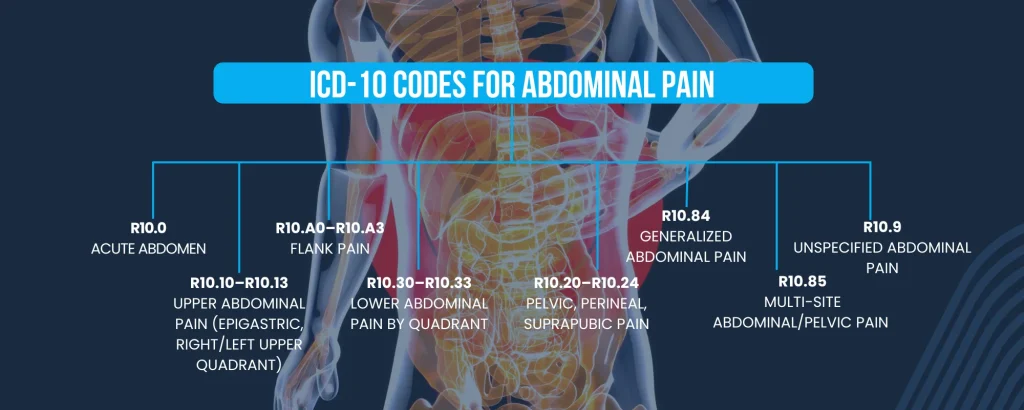
The FY 2026 ICD-10-CM update introduced major revisions to this category. New flank pain codes (R10.A0 through R10.A3), a multi-site pain code (R10.85), a code for suprapubic pain (R10.24), and updated pelvic laterality requirements (R10.20 through R10.24) went into effect on October 1, 2025. Health insurance plans are actively updating their claims processing logic to reflect these updates.
This guide provides a thorough review of every ICD-10 code for abdominal pain within the R10 family: what each code means, appropriate usage guidelines, documentation requirements for insurance approval, impact on DRG grouping, and common sources of claim denials. It is designed to help healthcare providers and billing departments process abdominal pain cases efficiently across all clinical specialties.
Need more accurate abdominal pain claims? Medmax Technologies LLC’s medical billing services ensure proper coding, reduce claim denials, and support faster reimbursements.
What Is the ICD-10 Classification System and How Does It Apply to Abdominal Pain?
ICD-10-CM is the standard diagnostic coding system that all HIPAA-covered healthcare providers in the United States must use. While the World Health Organization originally created the ICD-10 framework, CMS and the CDC maintain and update the clinical modification used across the U.S. each year.
Abdominal pain is classified under Chapter 18 (R00 through R99), which covers symptoms, signs, and abnormal findings not classified elsewhere. Within this chapter, R10 serves as the primary category for abdominal and pelvic pain. For FY 2026, R10 includes over 30 billable ICD-10 codes for abdominal pain, ranging from acute conditions and location-specific pain patterns to findings like tenderness, rebound response, colic, flank involvement, and unspecified pain.
Selecting the precise ICD-10 code abdominal pain designation is more than an administrative step. It determines whether a claim is processed smoothly on first submission or flagged for manual review. Every character within a code adds clinical detail that directly affects billing outcomes.

How ICD-10 Code Structure Works for Abdominal Pain (R10.xx)
Every abdominal pain ICD 10 CM code follows a structured format, where additional characters add higher levels of detail:
- First three characters (R10): The category identifier for abdominal and pelvic pain.
- Fourth character (location):
- 0 = Acute abdomen
- 1 = Upper abdomen
- 2 = Pelvic and perineal
- 3 = Lower abdomen
- 8 = Other abdominal pain (tenderness, rebound, colic, generalized)
- 9 = Unspecified
- A = Flank (introduced in FY 2026)
- Fifth character (laterality or precise anatomical site):
- 0 = Unspecified side
- 1 = Right side
- 2 = Left side
- 3 = Bilateral or periumbilical (depending on context)
- 4 = Suprapubic (under R10.2)
- Sixth and seventh characters: Applied to tenderness (R10.81x) and rebound tenderness (R10.82x) codes to specify the exact quadrant, periumbilical area, epigastric region, or generalized pattern noted during an exam.
Before 2015, abdominal pain was billed using ICD-9-CM codes 789.00 through 789.09. Transitioning to ICD-10-CM significantly expanded the available ICD 10 CM codes for abdominal pain, offering better clinical detail and more accurate reimbursement. This code set continues to evolve, with FY 2026 marking one of the largest updates to abdominal pain codes in recent years.
FY 2026 ICD-10-CM Update: What Changed for Abdominal Pain Codes
Effective October 1, 2025, the FY 2026 ICD-10-CM update added 487 new diagnosis codes across the healthcare system. Many of these changes directly impact the R10 abdominal and pelvic pain category, representing the most extensive update to these codes since 2015.
For medical billers, these additions require careful attention. New diagnostic codes introduce new documentation standards, while deleted codes will lead to immediate claim rejections if EHR systems are not kept up to date. Furthermore, because more specific choices are now available, insurance companies are more likely to reject claims that rely on unspecified codes when a detailed option could have been used.
New Flank Pain Codes (R10.A0 Through R10.A3)
Before FY 2026, there was no specific flank pain ICD 10 code. When patients presented with lateral abdominal or flank pain, providers had to choose less specific codes, often defaulting to R10.9 or a nearby location code.
Following a proposal by the American College of Emergency Physicians (ACEP) at the September 2023 ICD-10-CM Coordination and Maintenance Committee meeting, a dedicated subcategory with full laterality options was introduced:
| ICD-10 Code | Description |
|---|---|
| R10.A0 | Flank pain, unspecified side |
| R10.A1 | Flank pain, right side |
| R10.A2 | Flank pain, left side |
| R10.A3 | Flank pain, bilateral |
These options cover lateral abdominal pain, lateral flank pain, and latus region pain. They are commonly used when evaluating renal or ureteral issues, musculoskeletal strain, or kidney conditions. Whenever the affected side is known, use R10.A1 or R10.A2 instead of the unspecified code.
R10.2 Pelvic and Perineal Pain: Deleted and Replaced
R10.2 is no longer a valid standalone diagnosis code. As of October 1, 2025, a fifth character is required to identify laterality. Any claim submitted using only R10.2 will be returned as incomplete.
The updated pelvic pain code family includes:
| ICD-10 Code | Description |
|---|---|
| R10.20 | Pelvic and perineal pain, unspecified side |
| R10.21 | Pelvic and perineal pain, right side |
| R10.22 | Pelvic and perineal pain, left side |
| R10.23 | Pelvic and perineal pain, bilateral |
| R10.24 | Suprapubic pain |
The introduction of R10.24 provides a dedicated option for suprapubic abdominal pain ICD 10, which previously required workaround coding. This addition makes it easier to establish medical necessity for urological and gynecological evaluations.
R10.85 and R10.8A: Expanded Other Abdominal Pain Codes
FY 2026 also introduced codes to better address multi-site pain and specific area tenderness:
| ICD-10 Code | Description |
|---|---|
| R10.85 | Abdominal pain of multiple sites |
| R10.8A1 | Right flank tenderness |
| R10.8A2 | Left flank tenderness |
| R10.8A3 | Suprapubic tenderness |
| R10.8A9 | Flank tenderness, unspecified / NOS |
Code R10.85 is designed for cases where pain spans two or more distinct locations. However, strict Excludes1 rules apply. R10.85 cannot be billed on the same claim as R10.84 (generalized abdominal pain), R10.0 (acute abdomen with generalized pain), R19.3 (abdominal rigidity NOS), or localized codes from R10.1 through R10.4. Combining these mutually exclusive codes will lead to a claim rejection.
What Practices Need to Do
Insurance payers are applying greater scrutiny to R10.9 (unspecified abdominal pain) and R10.84 (generalized abdominal pain). Practices that continue relying on unspecified codes when medical records support a more exact diagnosis risk higher denial rates, payment delays, and audit reviews.
To prevent claim issues, update EHR templates, billing systems, and fee schedules promptly. Clinical teams should also be trained on the updated laterality rules for pelvic pain and the new flank-specific codes.
Complete FY 2026 ICD-10 Code Table for Abdominal Pain (R10.0 Through R10.A3)
The table below lists every billable ICD-10-CM code in the R10 family for FY 2026, along with clinical scenarios, expected documentation details, claim risk levels, and associated inpatient DRG mappings:
| ICD-10 Code | Description | Documentation Needed |
|---|---|---|
| R10.0 | Acute abdomen | Onset timing, red flag symptoms, urgency, differential diagnosis |
| R10.10 | Upper abdominal pain | Why quadrant wasn't specified |
| R10.11 | Right upper quadrant pain | Exact location, jaundice, nausea |
| R10.12 | Left upper quadrant pain | Exact location, exam findings |
| R10.13 | Epigastric pain | Meal relation, burning vs pressure |
| R10.20 | Pelvic/perineal pain, unspecified side | Why laterality not determined |
| R10.21 | Pelvic/perineal pain, right side | Laterality, GYN/urological symptoms |
| R10.22 | Pelvic/perineal pain, left side | Laterality, associated findings |
| R10.23 | Pelvic/perineal pain, bilateral | Bilateral documentation |
| R10.24 | Suprapubic pain | Location, urinary symptoms |
| R10.30 | Lower abdominal pain, unspecified | Why quadrant unspecified |
| R10.31 | Right lower quadrant pain | Exact quadrant, rebound, fever |
| R10.32 | Left lower quadrant pain | Exact quadrant, bowel symptoms |
| R10.33 | Periumbilical pain | Location relative to umbilicus |
| R10.811–R10.816 | Quadrant-specific abdominal tenderness | Objective exam vs subjective pain |
| R10.817 | Generalized abdominal tenderness | Negative focal findings |
| R10.819 | Abdominal tenderness, unspecified | Why site unspecified |
| R10.821–R10.829 | Rebound abdominal tenderness (by quadrant) | Clear rebound behavior documented |
| R10.83 | Colic | Episodic timing, age |
| R10.84 | Generalized abdominal pain | Justification for generalized diagnosis |
| R10.85 | Abdominal pain of multiple sites | Each site documented separately |
| R10.8A1–R10.8A3 | Flank/suprapubic tenderness (by site) | Laterality + exam findings |
| R10.8A9 | Flank tenderness, unspecified | Why laterality unknown |
| R10.A0 | Flank pain, unspecified side | Why side not specified |
| R10.A1 | Flank pain, right side | Laterality + urological review |
| R10.A2 | Flank pain, left side | Associated symptoms |
| R10.A3 | Flank pain, bilateral | Bilateral documentation |
| R10.9 | Unspecified abdominal pain | Clear reason for diagnostic uncertainty |
Critical Excludes Notes for Clean Claims
Correct code selection is only part of accurate medical billing. Pairing incompatible codes can trigger automated claim rejections.
- Type 1 Excludes for R10 (Cannot be billed together with any R10 code):
- Renal colic (N23). When renal colic is confirmed, bill N23 directly instead of an R10 code.
- Type 2 Excludes for R10 (May be billed together if both are documented):
- Dorsalgia (M54.-)
- Flatulence and related conditions (R14.-)
- Costovertebral angle tenderness (R39.85)
- Type 1 Excludes for R10.85 (Abdominal pain of multiple sites):
- R19.3 (abdominal rigidity NOS)
- R10.0 (generalized pain associated with acute abdomen)
- R10.84 (generalized abdominal pain NOS)
- R10.1 through R10.4 (localized abdominal pain codes)
Because these codes are mutually exclusive, listing R10.85 alongside any of them will result in an immediate rejection. When documenting pain across multiple sites, avoid adding separate localized or generalized pain codes on the same claim.
Doing Everything Right But Still Not Getting Paid….
Sometimes the problem isn’t your team—it’s the system. Our clients recover tens of thousands simply by letting us take a look.
- 98% Claim Approval Rate
- 24-hour Claim Turnaround
- 100% HIPAA-compliant
- Weekly, Monthly Reports
When to Use Definitive Diagnoses Instead of Symptom Codes
Codes in the R10 category describe symptoms. They are intended for encounters where a clear diagnosis has not yet been established. Once a definitive condition is confirmed, coding rules shift.
If conditions such as appendicitis (K35), cholecystitis (K80 through K82), diverticulitis (K57), or pancreatitis (K85) are diagnosed during the visit, bill the specific condition as the primary diagnosis. Under the ICD-10-CM Official Guidelines for Coding and Reporting, routine symptoms associated with an established disease process should not be billed separately once a definitive diagnosis is confirmed.
Exception: If abdominal pain occurs as an independent finding unrelated to the confirmed primary condition, it may be coded separately if the clinical notes clearly document that distinction.
Whether a provider searches using terms like stomach pain ICD-10, abdominal cramping ICD-10, belly pain ICD-10, or abd pain ICD-10, all map to the R10 family. The final code selection must always be guided by the clinician’s documentation rather than the patient’s description.
Understanding R10.9: Unspecified Abdominal Pain
What Does R10.9 Mean?
R10.9 is the official ICD-10-CM diagnosis code for unspecified abdominal pain. It is a billable code applied when a patient presents with abdominal pain, but its exact location, cause, or pattern cannot be determined from the available clinical information. It resides in Chapter 18 and has remained active since October 1, 2015, without structural modifications in FY 2026.
R10.9 is commonly used in clinical practice, but it frequently leads to billing challenges. Medical billers often select it when chart notes lack detail, and clinicians assign it when a diagnosis remains unclear. While both uses are allowed, relying on R10.9 without documenting why a precise location could not be determined increases the risk of claim denials.
R10.9 DRG Grouping and Reimbursement Impact
When R10.9 is billed as the principal diagnosis for inpatient care, it assigns to one of two Diagnostic Related Groups:
| DRG | Description | Applies |
|---|---|---|
| MS-DRG 391 | Esophagitis, gastroenteritis, and miscellaneous digestive disorders with MCC | R10.9 used as principal diagnosis with major complications or comorbidities (MCC) |
| MS-DRG 392 | Esophagitis, gastroenteritis, and miscellaneous digestive disorders without MCC | R10.9 used as principal diagnosis without major complications or comorbidities |
For inpatient admissions, R10.9 impacts Case-Mix Index calculations. On outpatient claims, insurance logic checks whether a more detailed code could have been selected. If chart notes describe a specific area while the claim specifies R10.9, the mismatch often triggers an audit or denial.
Exclusion Rules for R10.9
- Excludes1: Renal colic (N23). If renal colic is diagnosed, use N23 instead of R10.9.
- Excludes2: Dorsalgia (M54.-) and flatulence-related issues (R14.-). A patient evaluated for abdominal pain who also presents with back pain or gas may have both conditions coded on the same claim.
In the ICD-10-CM Alphabetic Index, the R10 9 diagnosis code is located under Pain(s) → abdominal → R10.9. Type 1 Excludes notes prevent reporting it with general pain codes (R52), while Type 2 Excludes notes connect it to other specific pain categories. Checking these reference notes helps prevent coding errors before claims are submitted.
R10.9 vs. R10.84: Key Differences
R10.9 (abdominal pain unspecified ICD 10) and R10.84 (generalized abdominal pain ICD 10) are frequently confused, but they are not interchangeable:
- R10.9 applies when the location and pattern of pain are entirely unknown.
- R10.84 applies when pain is present across the entire abdomen—meaning the location is known, but it is diffuse rather than localized.
Using R10.84 when pain is limited to a single quadrant creates audit risk. Conversely, submitting R10.9 when documentation describes diffuse, full-abdomen pain indicates a mismatch between medical records and submitted codes.
Appropriate Uses for R10.9
R10.9 is appropriate when clinical details are genuinely limited, such as:
- Initial evaluations where diagnostic workups are incomplete.
- Cases where pain moves across areas and cannot be localized.
- First-time patient visits with unclear presentation patterns.
- Encounters where the patient’s description conflicts with physical exam findings.
In all cases, clinical notes should explicitly state why the pain could not be localized.
When to Avoid R10.9
Avoid using R10.9 when physical examination reveals a clear quadrant, when a primary diagnosis has been confirmed, or when physician notes contain specific location details that were simply omitted from final code selection.
For example, if a physician notes “right lower quadrant tenderness with rebound,” but the claim lists R10.9 simply because the summary impression read “abdominal pain,” the documentation supported a higher level of coding specificity that was missed during claims entry.
Abdominal Pain ICD-10 Code Guidelines by Location
Identifying the precise location of pain is essential for proper code assignment. If a specific area cannot be identified during an exam, the chart documentation should reflect that finding (e.g., “Patient unable to localize pain”).
Upper Abdominal Pain ICD-10 Codes (R10.10 Through R10.13)
- R10.10: Unspecified upper abdominal pain. Use only when the quadrant cannot be identified.
- R10.11: Right upper quadrant abdominal pain ICD 10 (RUQ). Used for conditions affecting the gallbladder, liver, or right kidney. Chart notes should describe associated symptoms such as jaundice, nausea, or stool changes.
- R10.12: Left upper quadrant abdominal pain ICD 10 (LUQ). Applies to splenic, stomach, or left kidney conditions.
- R10.13: Epigastric abdominal pain ICD 10. Covers the upper central region below the sternum, commonly used for gastritis, peptic ulcers, GERD, or early pancreatitis. Notes should detail relationship to meals, pain characteristics (burning vs. pressure), and radiation patterns.
Lower Abdominal Pain ICD-10 Codes (R10.30 Through R10.33)
- R10.30: Unspecified lower abdominal pain. Use only when lower quadrant localization is not possible.
- R10.31: Right lower quadrant abdominal pain ICD 10 (RLQ). Frequently used during appendicitis evaluations. Documentation should note rebound tenderness, guarding, fever, and differential diagnoses.
- R10.32: Left lower quadrant abdominal pain ICD 10 (LLQ). Commonly assigned for diverticulitis, colonic issues, or left ovarian pathology. Documentation should note bowel symptoms and palpation findings.
- R10.33: Periumbilical abdominal pain ICD 10. Covers pain around the navel, such as early appendicitis, small intestine conditions, or umbilical hernias. Notes should indicate whether pain is migrating.
Right-Sided vs. Left-Sided Abdominal Pain ICD-10
Patients often describe pain simply as “right-sided” or “left-sided.” While searches for right sided abdominal pain ICD 10 and left sided abdominal pain ICD 10 are common, the system does not offer generic “side-only” codes. Pain must be assigned to an upper or lower quadrant.
- Right abdominal pain ICD 10: Evaluate for upper vs. lower quadrant involvement (liver/gallbladder vs. appendix/right kidney).
- Left abdominal pain ICD 10: Determine upper vs. lower quadrant location (spleen/stomach vs. descending colon/left ovary).
Generalized and Diffuse Pain Abdominal Pain ICD-10 (R10.84)
R10.84 (generalized abdominal pain ICD 10) applies when pain involves the entire abdomen, such as in gastroenteritis, IBS flare-ups, or widespread inflammatory conditions.
Medical records must confirm that a physical exam was performed and that no focal tenderness was found. R10.84 cannot be combined with R10.85 (abdominal pain of multiple sites).
Flank Pain ICD-10 Subcategory (R10.A0 Through R10.A3)
For flank-related pain, select the appropriate laterality code: R10.A1 for right flank pain ICD 10, R10.A2 for left flank pain ICD 10, R10.A3 for bilateral flank pain, or R10.A0 if the side is unspecified.
Abdominal Tenderness Abdominal Pain ICD-10 Codes vs. Pain (R10.811 Through R10.819)
Pain is a subjective symptom reported by the patient, while tenderness is an objective finding identified by the clinician during physical examination:
- R10.811: RUQ tenderness
- R10.813: RLQ tenderness
- R10.816: Epigastric tenderness
- R10.817: Generalized abdominal tenderness ICD 10
Subjective pain and objective tenderness can be reported together on the same claim if both are documented (e.g., patient reports generalized pain, but examination demonstrates focal RLQ tenderness).
Rebound Tenderness ICD-10 (R10.821 Through R10.829)
Rebound tenderness occurs when pain increases upon the sudden release of pressure, often indicating peritoneal irritation. Rebound codes are categorized by quadrant (R10.821 through R10.829) and should be documented clearly when present.
Abdominal Wall Pain ICD-10
Musculoskeletal issues, surgical scar tissue, or abdominal wall hernias fall under abdominal wall pain ICD 10 scenarios. Since there is no distinct standalone code for wall pain, select the corresponding R10 location code and ensure clinical notes clarify the origin (e.g., pain aggravated by movement or sit-ups vs. internal visceral pain).
Abdominal Pain ICD-10 Codes by Type and Characteristics
Acute Abdominal Pain (R10.0: Acute Abdomen)
R10.0 is the acute abdominal pain ICD 10 code used for sudden, severe pain that may indicate a surgical emergency (such as appendicitis, bowel obstruction, or perforation).
Documentation must support clinical urgency by noting rapid onset, physical findings like guarding or rigidity, differential diagnoses, and any surgical consultations. R10.0 carries a Type 1 Excludes note with R10.84.
Chronic Abdominal Pain ICD-10
There is no single, dedicated chronic abdominal pain ICD 10 code in the R10 family.
To bill chronic abdominal pain ICD 10 cases, report the appropriate location-based R10 code and document duration, frequency, and prior treatment history in the chart notes. When care is primarily focused on pain management, secondary codes such as G89.29 (other chronic pain) or G89.4 (chronic pain syndrome) may be added.
Intractable Abdominal Pain ICD-10
Similar to chronic pain, no specific intractable abdominal pain ICD 10 code exists within R10. Code the primary location using R10 and append G89.4 or G89.29 as secondary codes, ensuring chart notes detail failed treatments and ongoing functional impacts.
Severe, Intermittent, and Postoperative Pain
- Severe Pain: Use R10.0 if criteria for an acute abdomen are met. Otherwise, use the location code and document severity using a standard 1–10 scale.
- Intermittent Pain: Use R10.83 if pain fits a cramping, episodic colic pattern. Otherwise, use the appropriate location code with supporting chart notes.
- Postoperative Pain: Bill G89.18 (acute post-procedural pain) or G89.28 (chronic post-procedural pain) as the primary code, followed by the specific R10 location code as secondary.
Abdominal Pain Colic (R10.83)
R10.83 applies to intermittent, cramping pain, primarily in pediatric patients (ages 0–17). Documentation should describe episode timing, duration, and associated behaviors like crying or feeding refusal.
Coding Abdominal Pain with Associated Symptoms
When accompanying symptoms are present, report them alongside the primary location code to reflect full clinical complexity:
- Abdominal pain with nausea ICD 10: R10 location code + R11.0 (nausea)
- Abdominal pain with vomiting ICD 10: R10 location code + R11.2 (nausea with vomiting)
- Abdominal pain with diarrhea ICD 10: R10 location code + R19.7 (diarrhea, unspecified)
- Abdominal pain and bloating ICD 10: R10 location code + R14.0 (abdominal distension)
- Abdominal pain after eating ICD 10: Select the matching R10 location code and document the postprandial trigger in the clinical notes. There is no standalone code for “pain after eating,” so the meal relationship must be clearly documented.
Every additional symptom code adds clinical context that supports medical necessity. Including all relevant secondary symptoms gives insurance payers the detailed documentation required to justify the billed level of service.
Abdominal Pain in Pregnancy ICD-10 Codes: Trimester-Specific Guidelines
Coding abdominal pain in pregnancy ICD 10 cases requires navigating two distinct code sets. Choosing the correct path is critical for proper claim processing on obstetric claims.
ICD-10-CM provides two main pathways: general R10 symptom codes and Chapter 15 O-codes (O00 through O9A) for pregnancy-specific conditions. The correct choice depends on whether the abdominal pain is directly related to the pregnancy or is an independent issue occurring concurrently.
Selecting the Correct Category: R10 vs. O-Codes
- Pregnancy-Related Pain: When pain is caused by factors such as round ligament stretching, Braxton Hicks contractions, or uterine growth, use Chapter 15 O-codes as the primary diagnosis. In these cases, the pregnancy represents the primary clinical context.
- Non-Obstetric Pain During Pregnancy: When pain stems from unrelated conditions (such as a gastritis flare, constipation, or muscle strain), report the appropriate R10 code along with Z33.1 (pregnancy state, incidental). This establishes that the patient is pregnant without incorrectly attributing the pain to the pregnancy.
- Unclear Clinical Picture: If the exact origin is uncertain during the visit, document the clinical uncertainty. Dual coding is accepted when supported by chart notes.
Common code combinations include:
| Code | Description | Context |
|---|---|---|
| O20.0 | Threatened abortion | First-trimester bleeding with abdominal pain |
| O26.89 | Other specified pregnancy-related conditions | Pregnancy-related pain not otherwise specified |
| O99.89 | Other specified diseases complicating pregnancy | Non-obstetric abdominal condition occurring during pregnancy |
| R10.30 + Z33.1 | Lower abdominal pain + pregnancy state, incidental | Non-obstetric lower abdominal pain in a pregnant patient |
The ICD 10 code for abdominal pain in pregnancy influences payment and DRG assignments. Under official Chapter 15 guidelines, pregnancy-related conditions require an O-code as the principal diagnosis. Non-obstetric conditions use O99 codes if they complicate the pregnancy, or R-codes paired with Z33.1 if they are purely incidental.
Trimester-Specific Documentation Standards
Chapter 15 O-codes require a trimester designation. Clinicians must document gestational age so billers can apply the correct trimester character.
- Abdominal pain during pregnancy first trimester ICD 10: These visits are often complex because differentials include ectopic pregnancy, threatened abortion, implantation discomfort, and non-obstetric causes. Notes should capture gestational age, bleeding status, ultrasound findings, and clinical impressions regarding obstetric involvement.
- Abdominal pain in pregnancy second trimester ICD 10: Common causes include round ligament pain, Braxton Hicks contractions, or preterm labor concerns. Notes should include fetal status, contraction evaluations, and cervical findings.
- Abdominal pain in pregnancy third trimester ICD 10: High-acuity concerns like placental abruption, preterm labor, and preeclampsia require thorough, rapid documentation supporting the level of emergency care.
- Lower abdominal pain in pregnancy ICD 10: Very common across all trimesters. Clinicians must decide whether to bill R10.30 with Z33.1 or assign an O-code based on the suspected pain source.
ICD-10 Abdominal Pain Documentation Guidelines
Accurate coding depends on complete clinical notes. Most claim rejections stem from gaps between what occurred during the patient visit and what was documented in the medical record.
Guidelines for R10 Codes
Official Guidelines for R10 Codes
The FY 2026 ICD-10-CM Official Guidelines for Coding and Reporting outline key rules governing the R10 family:
- Symptom codes (R10) are appropriate when a definitive diagnosis is not established by the end of the encounter.
- Assign codes to the highest level of detail supported by the medical record (e.g., use quadrant-specific codes when notes indicate location).
- Do not code routine symptoms separately if they are inherent to an established diagnosis (e.g., appendicitis pain is captured under K35, not R10.31).
- Replace R10 symptom codes with definitive condition codes once a final diagnosis (like cholecystitis or diverticulitis) is confirmed.
- R10.85 (multiple sites) cannot be billed alongside localized codes (R10.1–R10.4) or generalized pain (R10.84).
Documentation Checklist to Prevent Claim Denials
Every chart note for an abdominal pain visit should include the following core details:
- Location: Specific quadrant, named region, or diffuse across the entire abdomen.
- Laterality: Right, left, bilateral, or an explicit note explaining why laterality cannot be determined.
- Duration: Onset timing, acute vs. chronic classification, and constant vs. intermittent patterns.
- Character: Description of pain (sharp, dull, burning, cramping, pressure, colicky).
- Severity: Pain scale score (1–10) or functional impact details.
- Associated Symptoms: Presence or absence of nausea, vomiting, fever, bowel changes, urinary symptoms, or pregnancy.
- Exam Findings: Objective findings, including palpation tenderness, rebound tenderness, guarding, rigidity, and bowel sounds.
- Medical Decision-Making: Rationale explaining why a definitive diagnosis was not reached during the encounter, along with ordered tests and follow-up plans.
Including a brief sentence explaining why the diagnosis remained at the symptom level helps substantiate the claim during review.
Common Coding Errors and Corrective Actions
The table below outlines common documentation errors that lead to claim rejections:
| Common Error | Why Insurance Denies the Claim | Corrective Action |
|---|---|---|
| Selecting R10.9 when the exam shows a specific quadrant | Diagnosis code does not match documented exam findings | Use the quadrant-specific code (e.g., R10.31, R10.32) |
| Using R10.84 when pain is actually localized | Generalized pain code applied to focal pain | Document the true distribution and code accordingly |
| Not distinguishing tenderness from pain | Missing objective exam detail that changes code selection | Clearly state tenderness findings in the physical exam |
| Keeping R10 symptom code when a definitive diagnosis was confirmed | Symptom code used instead of confirmed condition | Code the confirmed diagnosis instead of the symptom |
| Submitting R10.2 without a fifth digit | Incomplete code after FY 2026 deletion | Add laterality: R10.20 through R10.24 |
| No documented reason for uncertainty | Medical necessity questioned during audit | Add one sentence explaining why localization was not possible |
CPT Codes and Insurance Review Patterns
CPT Alignment for Abdominal Pain Visits
Diagnosis codes do not exist in isolation; they validate the medical necessity of the billed service. For office visits, R10 codes support Evaluation and Management (E/M) CPT codes 99202 through 99215.
Additionally, many insurance payers require specific location-based R10 codes—rather than generic R10.9—to approve coverage for diagnostic imaging orders, including CT scans, abdominal ultrasounds, and MRIs. If the diagnostic code on the imaging order does not meet the payer’s medical necessity criteria, the imaging claim may be denied.
How Insurance Payers Review Abdominal Pain ICD-10 Claims
Insurance review systems monitor abdominal pain claims closely due to the wide variation in potential underlying causes—ranging from mild indigestion to surgical emergencies.
When payer algorithms detect frequent submissions of R10.9 or R10.84 from the same provider, claims are often flagged for automated or manual documentation reviews to verify that the billed level of service matches the medical records.




Jessica Collins
Jessica Collins is a Medical Coding Expert with 9+ years of experience in ICD-10, CPT coding, clinical documentation, and revenue cycle management. She shares practical insights to improve coding accuracy, billing efficiency, and healthcare compliance.