





COPD ICD 10 Codes: Chronic Obstructive Pulmonary Disease
Chronic obstructive pulmonary disease (COPD) is a long-term lung condition caused by damage to the lungs, according to the Mayo Clinic. COPD blocks airflow and makes normal breathing difficult. Emphysema and chronic bronchitis are the two main conditions that make up COPD, and they often occur together. The American Lung Association estimates that COPD affects 11.7 million adults and leads to hundreds of thousands of emergency department visits each year, costing the healthcare system tens of billions of dollars annually.
Accurately coding chronic respiratory conditions such as COPD can be challenging because of the complexity of the disease, similar symptoms, and the need to clearly identify chronic, acute, and exacerbated conditions. ICD-10-CM guidelines require coders to carefully review Excludes1 and Excludes2 notes, combination coding rules, and the level of detail in the medical documentation. Coding mistakes can result in claim denials, delayed payments, and compliance issues. As a medical billing company that manages a large number of claims related to COPD, we have extensive experience with the ICD-10 coding challenges associated with this condition.
Causes and Symptoms
COPD includes several chronic and progressive lung diseases that block airflow. Smoking is the most common cause, but other environmental and genetic factors can also contribute to the condition.
- Smoking — the main cause of COPD
- Long-term exposure to environmental irritants such as toxic fumes, dust, air pollution, and secondhand smoke
- A history of serious respiratory infections during childhood, such as pneumonia
- Gastroesophageal reflux disease (GERD), which may cause or make COPD worse
- Genetics — a deficiency of alpha-1 antitrypsin (AAT), a protein made by the liver
Common symptoms of COPD include a long-term cough, coughing up large amounts of mucus, shortness of breath that becomes worse with physical activity, wheezing, chest tightness, fatigue, and low blood oxygen levels. COPD exacerbations, also called symptom flare-ups, can range from mild to life-threatening.
ICD-10 Codes for COPD
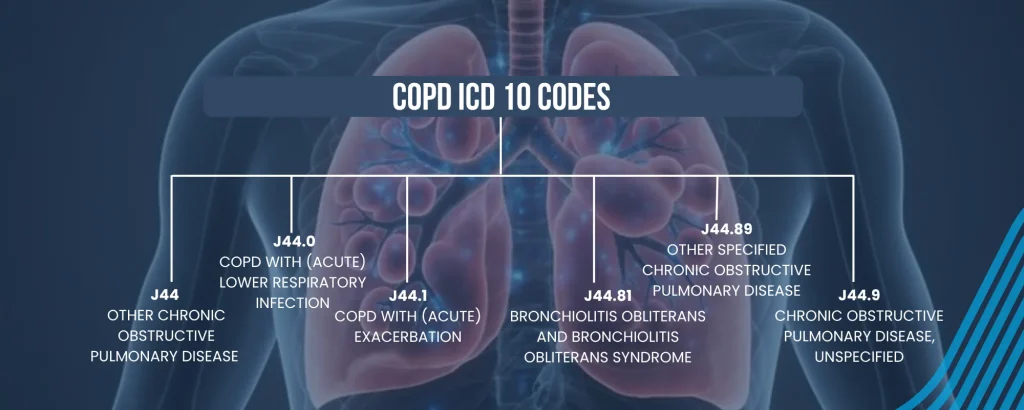
COPD is a broad term that can include conditions such as emphysema, asthma, and chronic bronchitis, which can cause airway obstruction, according to AHA’s ICD-10-CM and ICD-10-PCS Coding Handbook Revised 2024 Edition. COPD commonly develops along with conditions such as chronic bronchitis or emphysema. In ICD-10, these conditions are classified under category J44, Other chronic obstructive pulmonary disease. A fourth character gives additional information about the condition:
| ICD-Code | Description | When to Use |
|---|---|---|
| J44 | Other chronic obstructive pulmonary disease | Includes asthma with COPD, chronic asthmatic bronchitis, chronic obstructive asthma, and other related diagnoses |
| J44.0 | COPD with (acute) lower respiratory infection | Used when a patient with COPD develops an acute lower respiratory infection, such as bronchitis or pneumonia |
| J44.1 | COPD with (acute) exacerbation | Used when COPD symptoms become worse, such as increased shortness of breath or wheezing, without an infection |
| J44.81 | Bronchiolitis obliterans and bronchiolitis obliterans syndrome | Documented BOS, most often post-transplant. Not interchangeable with routine COPD. |
| J44.89 | Other specified chronic obstructive pulmonary disease | COPD documented with chronic bronchitis, asthma, or emphysematous bronchitis, per the Alphabetic Index. |
| J44.9 | Chronic obstructive pulmonary disease, unspecified | Used when the documentation does not identify the specific type of COPD |
ICD-10 Tips for Accurate COPD Claim Submission
- Scrutinize Provider Documentation
The code selected must match the diagnosis documented by the healthcare provider. Coders should carefully review the medical record before choosing the appropriate code. Here’s an example from a Find-a-code article:- Report J44.0 when the documentation shows that a patient with COPD has an acute lower respiratory infection, such as acute bronchitis.
- If the patient has an acute exacerbation of COPD along with chronic bronchitis, report J44.1 and a code for chronic bronchitis (J42).
- Do not Code Symptoms explained by a Confirmed Diagnosis
According to ICD-10-CM coding guidelines, symptoms generally should not be coded separately when they are already explained by a confirmed diagnosis. For example, if the documentation shows that a patient is a smoker with COPD and acute bronchitis and has symptoms such as shortness of breath and cough, assign the following codes:
- J44.0 Chronic obstructive pulmonary disease with acute lower respiratory infection
- F17.210 Nicotine dependence, cigarettes, uncomplicated
In this case, separate codes for cough and shortness of breath are not assigned because these symptoms are associated with the confirmed COPD and acute bronchitis diagnoses.
- Know the Codes for Other Respiratory Illnesse
Another challenge is correctly coding COPD when the patient also has another respiratory condition, such as asthma, emphysema, or bronchiectasis. Pulmonology coders need to understand the codes and guidelines for these conditions to ensure accurate coding of chronic respiratory conditions.
- COPD with coexisting asthma COPD
COPD with unspecified asthma is included under category J44 and is coded to J44.9. When the type of asthma is documented, two codes are assigned: one code from category J44 for COPD and another code from category J45 to identify the type of asthma. Subcategories under J45 include:
- J45.2- Mild intermittent asthma
- J45.3- Mild persistent asthma
- J45.4- Moderate persistent asthma
- J45.5- Severe persistent asthma
- J45.9- Other and unspecified asthma
Additional fifth and sixth characters show whether the asthma is uncomplicated, with exacerbation, or with status asthmaticus.
When the medical record documents both an acute exacerbation of asthma AND status asthmaticus, assets.humana.com explains that only the code for the more severe condition, status asthmaticus, should be assigned.
- COPD with acute exacerbation and acute bronchitis
An exacerbation of COPD is a temporary worsening, flare-up, or decompensation of symptoms. It means that the chronic condition has become worse and is not the same as an infection, although infections can trigger a COPD exacerbation.
Code J44.1, COPD with acute exacerbation, should be used when the documentation clearly states that the patient has a worsening of respiratory symptoms beyond their normal day-to-day condition and that treatment needs to be changed.
This code has an Excludes2 note stating that code J44.0 is not included in the condition represented by J44.1. This means both codes may be assigned when the medical record confirms that both conditions are present.
COPD with acute bronchitis, which is an acute infection, is coded as:
- J44.0 Chronic obstructive pulmonary disease with (acute) lower respiratory infection
- J20.9 Acute bronchitis, unspecified
- COPD with bronchiectasis
When COPD and bronchiectasis are documented together, ICD-10 guidelines state that only a code from category J47 should be assigned. Category J44 has an Excludes1 note for COPD with bronchiectasis and directs the coder to category J47, bronchiectasis. Category J47 includes several instructional notes and fourth characters that provide more detail about the condition.
- Emphysema
When emphysema is documented along with chronic bronchitis, the condition is classified under category J44. Emphysema without documentation of chronic bronchitis is classified under category J43.
- Other Specified and Unspecified Codes
When the documentation does not provide enough information to select a specific COPD code, an unspecified code should be used. However, when a specific type of COPD is documented but there is no exact ICD-10-CM code for it, report J44.89 (Other specified COPD). For example, J43.8 (Other specified emphysema) represents a specified type of emphysema. If the documentation does not support that diagnosis, J44.89 may be used when appropriate.
- Follow Instructional Notations and Guidelines
Following instructional notes and guidelines such as Excludes1, Excludes2, Code Also, and Use Additional is important for complete and accurate coding. These instructions also help coders report the highest level of specificity supported by the documentation.
For example, J44 has an Excludes1 note that prevents reporting codes in that category with J43.9 Emphysema, unspecified. If the documentation shows a patient with emphysema who also presents with asthma and COPD, HCPCS Coding Clinic® (vol. 6, no. 1) instructs coders to report J43.9 for emphysema and a code from J45.- for asthma. The reason is that emphysema is a more specific form of COPD, so an additional code for unspecified COPD is not necessary (aapc.com/blog).
To reduce COPD coding errors, coders must carefully review the notes in the ICD-10 Tabular List. Payers closely monitor compliance with Excludes1 notes, so following these coding instructions can help reduce claim denials.
Conclusion
Accurately coding COPD and related conditions requires a strong understanding of ICD-10 pulmonary disease coding guidelines, including Excludes1 and Excludes2 notes, combination coding, and documentation specificity. Distinguishing between acute exacerbations, infections, and other overlapping respiratory conditions can make pulmonology coding especially difficult. Coding errors may result in claim denials, lost revenue, and compliance risks.
By outsourcing medical billing and coding to experienced professionals, healthcare providers can improve coding accuracy, reduce administrative work, and achieve better reimbursement results. Expert coders carefully review physician documentation for COPD and stay updated on the latest regulatory changes. This helps ensure accurate coding and claim submission while reducing denials and optimizing revenue cycle efficiency. Experienced professionals also follow best practices for coding moderate to severe COPD, helping optimize reimbursement while allowing healthcare providers to focus on delivering quality patient care.



Jessica Collins
Jessica Collins is a Medical Coding Expert with 9+ years of experience in ICD-10, CPT coding, clinical documentation, and revenue cycle management. She shares practical insights to improve coding accuracy, billing efficiency, and healthcare compliance.