






E03.9 Diagnosis Code: Hypothyroidism ICD-10
The search for the right code for hypothyroidism in medical billing can be challenging because medical coders have several options under the ICD-10 category for hypothyroidism. This can make it confusing for healthcare providers to decide which code is the most suitable for a particular case. However, it is important to understand that choosing the correct code plays a major role in getting a claim accepted.
To help providers better understand the coding process, we have collected detailed information about one of the important Hypothyroidism ICD-10 codes, E03.9, which refers to “Unspecified Hypothyroidism.” So, without any delay, let’s take a closer look at this code and learn what it means and when it should be used.
What is Hypothyroidism?
The thyroid is a small, butterfly-shaped gland located at the base of the neck. It produces hormones that help the body control metabolism. These hormones also provide energy to almost every organ and help regulate important functions, including the heartbeat and digestive system.
The American Thyroid Association estimates that around 20 million Americans have some form of thyroid disease, and about 60% of them are not aware that they have it.
Hypothyroidism is a condition in which the thyroid gland does not produce enough thyroid hormones. When thyroid hormone levels are not balanced, many of the body’s normal functions begin to slow down. This can affect several chemical processes that normally take place in the body.
The symptoms of thyroid disorders can also develop very slowly and may take years to become noticeable. Even when symptoms appear, some can be mild or similar to symptoms of other conditions, such as fibromyalgia and rheumatoid arthritis. If hypothyroidism is not treated on time, it can lead to several other health problems, including heart disease, obesity, joint pain, and infertility.
In medical billing and coding in Texas, several codes can be used for hypothyroidism. To reduce the chances of claim denials, many endocrinologists outsource these tasks to experienced medical billing companies.

Clinical Features of Hypothyroidism
Hypothyroidism can cause different symptoms that affect energy levels, weight, mood, and normal physical functions. Some of the most common symptoms include:
Initial Symptoms:
- Fatigue and depression
- Weight gain
- Muscle weakness
- Muscle stiffness, aches, and tenderness
- Feeling cold
- Dry skin
- Constipation
- Slowed heart rate
- Puffy, sensitive face
- Pain and stiffness in your joints
- Impaired memory
- Hoarseness
- Fertility difficulties or menstrual changes
- Elevated blood cholesterol
- Dry, thinning hair
- Decreased sweating
As the disease progresses, other noticeable effects may develop. These can include confused senses, swelling around the eyes, slow speech, thinning hair, and a reduced pulse rate. Severe symptoms, such as myxedema coma, require immediate medical attention.
In simple terms, hypothyroidism can be caused by autoimmune diseases, surgical thyroid removal, certain medications, and iodine deficiency. The diagnostic process usually includes reviewing the patient’s medical history and performing blood tests to measure thyroid-stimulating hormone (TSH) and, in some cases, thyroxin (T4).
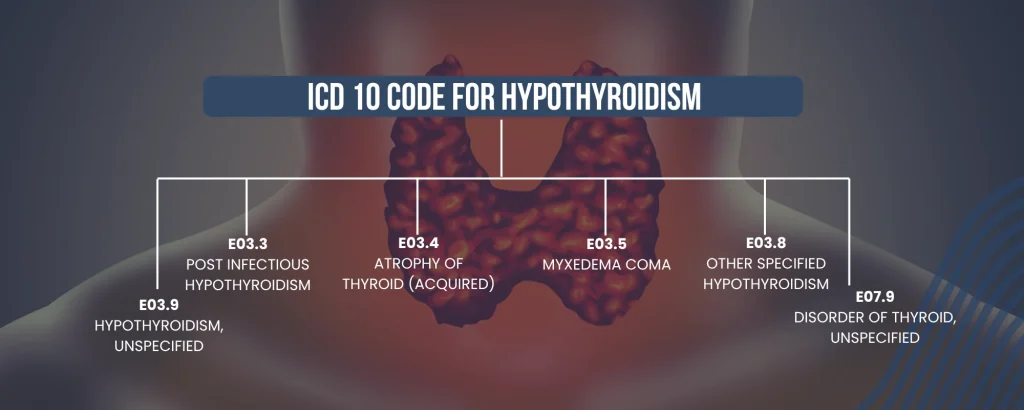
Commonly Used ICD-10-CM Codes for Hypothyroidism
| ICD-10 Code | Description |
|---|---|
| E01.8 | Other iodine deficiency related thyroid disorders and allied conditions |
| E02 | Subclinical iodine-deficiency hypothyroidism |
| E03.0 | Congenital Hypothyroidism with diffuse goiter |
| E03.1 | Congenital Hypothyroidism without goiter |
| E03.2 | Hypothyroidism due to medicaments and other exogenous substances |
| E03.4 | Atrophy of thyroid (acquired) |
| E03.5 | Myxedema coma |
| E03.8 | Other specified hypothyroidism |
| E03.9 | Hypothyroidism, hypothyroidism |
| E89.0 | Post-procedural Hypothyroidism |
Billable ICD 10 Code For Hypothyroidism
The main billable ICD-10 code for hypothyroidism is E03.9. This code refers to “Unspecified hypothyroidism.” Providers use it when hypothyroidism has been diagnosed, but the specific type or cause has not been clearly identified.
As mentioned earlier, E03.9 is a billable code. However, providers should use a more specific code whenever enough information is available. Using the correct code helps classify the disease accurately and can also support faster claim processing. Complete documentation and a clear understanding of the patient’s condition are important for selecting the right code.
E03.9 in Detail: Key Information You Need to Know
Definition and Usage
ICD-10 code E03.9 refers to “Unspecified Hypothyroidism.” This code should be used when hypothyroidism has been confirmed, but the exact cause or type has not been identified. For example, if a doctor confirms that a patient has hypothyroidism but has not yet determined whether it is caused by an autoimmune condition, iodine deficiency, or another reason, E03.9 may be appropriate.
Why the Term “Unspecified”?
The term “Unspecified” is used when a condition has been diagnosed, but there is not enough information to place it into a more specific category. This helps prevent incorrect coding when the exact cause or type of the condition has not yet been established. However, it can also indicate that additional evaluation may be needed.
Subclinical hypothyroidism is an early form of hypothyroidism in which the thyroid gland starts producing lower-than-normal thyroid hormones, but symptoms may be mild or may not appear at all.
Iodine is an essential mineral that the thyroid gland needs to produce the thyroid hormones thyroxine (T4) and triiodothyronine (T3). These hormones help regulate metabolism, energy production, growth, and the normal functioning of many organs and body tissues. The subclinical hypothyroidism ICD 10 code is E02.
Best Practices for Coding E03.9
Accurate coding is important for proper reimbursement and helps ensure that patients receive the appropriate diagnosis and care. When using ICD-10 code E03.9 for unspecified hypothyroidism, healthcare providers should follow the best practices below to help reduce coding errors and claim denials.
Diagnosis of Hypothyroidism Before Using E03.9
Before assigning the ICD-10 code for hypothyroidism, E03.9, a healthcare provider should confirm that the patient has a definitive diagnosis of hypothyroidism. This means the doctor should have enough clinical and laboratory evidence to determine that the patient has low thyroid hormone levels. Blood tests such as TSH (Thyroid Stimulation Hormone) or T4 are commonly used as part of the evaluation.
A preliminary diagnosis based only on symptoms such as fatigue, weight gain, or depression may not be enough. Laboratory results and a proper clinical evaluation are important when diagnosing hypothyroidism. Using E03.9 without sufficient confirmation can result in coding errors and may affect claim processing.
Document Accurately
Complete documentation is essential when using ICD-10 codes, especially when the patient’s condition is complex or currently unspecified. Patient history, clinical findings, and diagnostic test results should be clearly recorded in the medical record.
Proper documentation makes it easier to review and update the E03.9 code when more information becomes available. Clear and complete records also help support medical necessity and can reduce the chances of claim denials caused by documentation problems.
Revisit Diagnosis Regularly
For patients with unspecified hypothyroidism, the diagnosis should be reviewed regularly. If additional tests or evaluations identify the cause of hypothyroidism, the ICD-10 code should be updated to reflect the new information.
For example, if additional thyroid function tests and/or imaging studies indicate a more specific thyroid condition, the healthcare provider should select the appropriate specific ICD-10 code rather than continuing to use E03.9. This helps ensure that the diagnosis remains accurate and reflects the patient’s current condition.
Consult with Coding and Billing Team
Healthcare providers should work closely with their medical coding and billing teams throughout the coding process. This helps ensure that diagnosis codes are assigned correctly and that the latest coding guidelines are followed.
Coding specialists can provide valuable support when providers are unsure about selecting a specific code, especially when coding guidelines or best practices have recently changed.
Keeping providers, coders, and billing staff aligned with current coding standards improves both accuracy and efficiency. Regular training and updates from trusted sources such as the CDC or CMS can also help teams stay informed, reduce coding mistakes, and avoid potential claim denials.




Jessica Collins
Jessica Collins is a Medical Coding Expert with 9+ years of experience in ICD-10, CPT coding, clinical documentation, and revenue cycle management. She shares practical insights to improve coding accuracy, billing efficiency, and healthcare compliance.