






ICD-10 Code for Fatigue: Codes, Documentation & Tips
Assume you’re in a busy primary care clinic on a Monday morning. The next patient is a 43-year-old professional who starts the visit with a common concern: “I’m just exhausted all the time.” The patient reports feeling tired by the middle of the week and relying heavily on caffeine. There is no fever, no acute illness, and no single symptom that clearly explains the problem. The provider asks more questions and finds that the fatigue gets worse in the afternoon. The patient also reports poor sleep, trouble concentrating, and ongoing stress at work. In the medical record, the physician describes the fatigue-related concerns as “chart overload,” “caffeine deficiency,” and “midweek lag.”
Fatigue-related symptoms are common and can be difficult to evaluate in primary care. They are estimated to account for about 10-20% of all consultations. Work-related stress and fatigue in modern life can appear through symptoms and descriptions such as chart overload, a simple way of describing burnout, as well as caffeine withdrawal and midweek lag.
However, while burnout and fatigue are frequently reported in clinical settings, they can also be challenging to document and code correctly. This is why accurate ICD-10 code for fatigue-related symptoms is important. Correct coding connects the provider’s clinical intent with the patient’s condition and payer requirements. It also helps ensure that the medical record accurately reflects the reason for care and supports reimbursement and data reporting. The good news is that physicians can now use AI-powered medical coding to improve the accuracy and consistency of medical coding for fatigue symptoms.
This blog explains ICD-10 coding for burnout, fatigue, and caffeine dependence. It also covers important documentation requirements, related codes, and best practices used by experienced medical coding teams to support accuracy, compliance, and clinical integrity.

ICD-10 Code Selection for Fatigue-related Symptoms – Key Considerations
Terms such as “chart overload,” “caffeine deficiency,” and “midweek lag” may be easy to understand in everyday conversations, but they are not recognized medical diagnoses and do not have their own ICD-10 codes. Under the ICD-10 system, fatigue is generally reported with symptom-based codes. Choosing the right code requires a complete clinical assessment that explains the patient’s symptoms, including their severity, duration, and specific characteristics.
Clinically, fatigue can appear as general tiredness, low energy, malaise, or ongoing exhaustion. It can also occur along with an underlying medical condition, mental health disorder, or lifestyle factor. Because payers may closely review symptom-based ICD-10 fatigue codes, especially in value-based care settings, accurate documentation is very important. Medical necessity, documentation accuracy, fraud and abuse prevention, and cost control all depend on correct coding. Unsupported or inaccurate coding can result in claim denials, lower reimbursement, or compliance concerns.
To support accurate coding of fatigue-related symptoms, providers should document the patient’s condition clearly and in enough detail for coders to select the correct ICD-10 code. The documentation should help distinguish fatigue from similar or related conditions. It should also identify any contributing conditions or comorbid diagnoses that are part of the patient’s overall clinical picture.
Common Fatigue-related Symptoms and their ICD-10 Codes
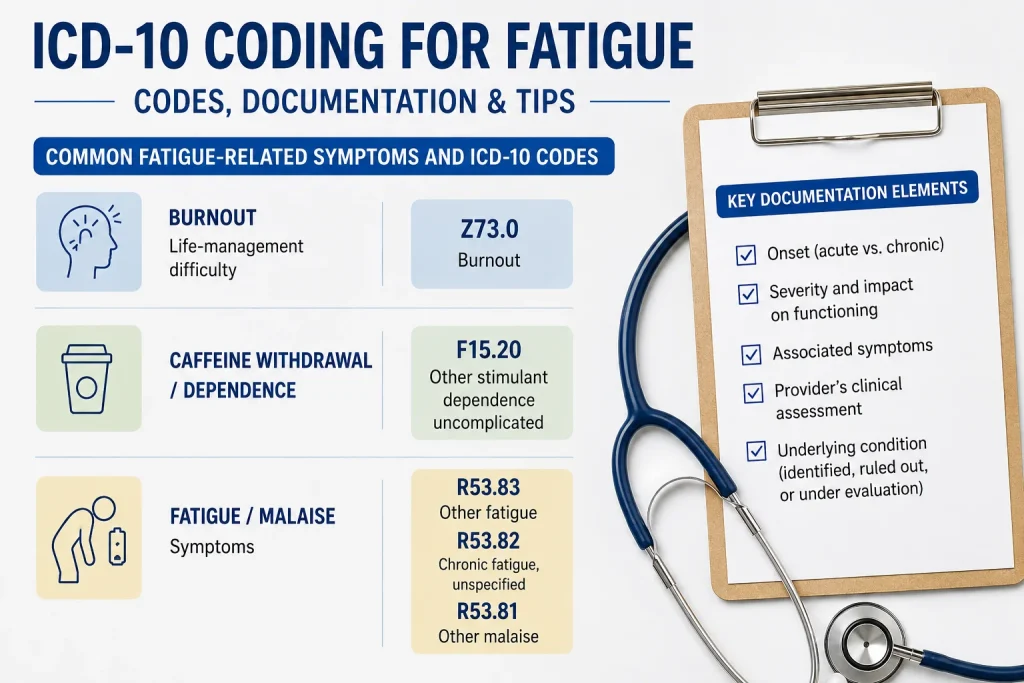
Chart Overload (Burnout)
In ICD-10, Z73.0 identifies burn-out and is included under the broader Z73 category, “Problems related to life-management difficulty.”
This code is used to identify burnout as a life-management difficulty. Although burnout is often connected with occupational or work-related stress, it may also be related to stress from other areas of life. Common characteristics can include low energy, emotional or mental distance, negative or cynical feelings, and reduced effectiveness.
It is important to understand that Z73.0 is not a disease or injury code. It is used when a person receives healthcare for circumstances or life-management challenges that affect their health status but do not represent a current, diagnosable illness or physical injury.
ICD-10 codes related to burnout:
- Z73 Problems related to life-management difficulty
- Z73.0 Burnout
- Z73.3 Stress, not elsewhere classified, For general stress that is not connected to specific work factors
- Z56 Problems related to employment and unemployment
- Z56.3 Stressful work schedule, For problems specifically related to demanding work hours or shifts
- Z56.6 Other physical and mental strain related to work, A broader code for stress or strain caused by the job
- R45.7 State of emotional shock and stress, unspecified
If the stress results in a diagnosable mental health condition, such as an adjustment disorder or severe stress reaction, codes from the F43.- range, Reaction to severe stress, and adjustment disorders, may be appropriate instead.
Documentation for Z73.0
Documentation for Z73.0 should clearly show that the provider is addressing burn-out as a life-management difficulty rather than diagnosing a medical or mental health disorder. Because it is a status/situational code, the medical record should contain enough information to support its use and meet payer expectations.
Important documentation elements include an explicit provider statement of burnout, a description of the main characteristics such as exhaustion, mental detachment, or reduced effectiveness, and the work or life stressors contributing to the problem. The provider should also document how the condition affects the patient’s daily activities or job performance.
The record should include the reason for the visit, the provider’s assessment, and the plan of care. When appropriate, the provider should document the evaluation or exclusion of other diagnosable conditions.
Common mistakes include using general or unclear symptom terms, assigning Z73.0 when a diagnosable condition is actually present, or depending only on the patient’s report of fatigue. The medical record should support burn-out as a contextual factor affecting health and should not use it as a replacement for a confirmed medical or psychiatric diagnosis.
Caffeine Deficiency – Caffeine Withdrawal/Dependence
The American Medical Association (AMA) reports that about 85% of adults consume 135 milligrams of caffeine daily in the U.S. This is approximately equal to 12 ounces of coffee, which is the most common source of caffeine for adults. The Food and Drug Administration (FDA) considers less than 400 milligrams of caffeine per day to be safe for most adults, which is about two to three 12-ounce cups of coffee a day.
The term “caffeine deficiency” is not generally used as the formal medical description of the problem. In a clinical context, symptoms that appear after stopping or reducing caffeine may be described as caffeine withdrawal. Caffeine withdrawal is recognized within the ICD-10 system.
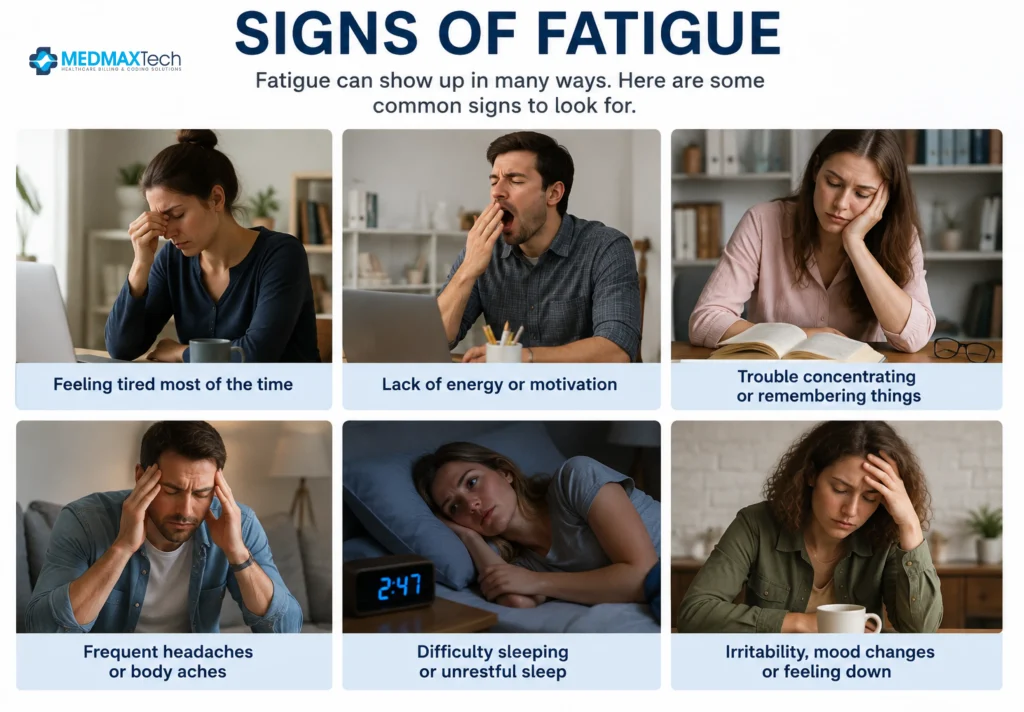
Caffeine deficiency symptoms can develop after a person stops or reduces caffeine intake. These symptoms can indicate that physical dependence has developed from regular caffeine use. Common symptoms include:
- Headaches
- Fatigue and decreased energy/activeness
- Drowsiness and sleepiness
- Irritability and depressed mood
- Difficulty concentrating or feeling “foggy”
- Nausea, vomiting, or other flu-like symptoms
These symptoms can occur after stopping even relatively low amounts of caffeine, such as one small cup of coffee per day, or around 100 mg. Symptoms often begin 12 to 24 hours after the last caffeine intake, may peak around 20 to 51 hours, and can continue for up to nine days.
The ICD-10 codes for caffeine dependence are included under the F15 category for “Mental and behavioral disorders due to use of other stimulants, including caffeine.” Key ICD-10 codes for caffeine dependence include:
- F15.2 Dependence syndrome due to other stimulants (including caffeine)
- F15.20 Other stimulant dependence uncomplicated
- F15.23 With withdrawal (e.g., headache, fatigue, nausea)
- F15.28 Other specified disorders (e.g., with sleep disorder)
- F15.3 Withdrawal state (for caffeine withdrawal)
- F15.4 Withdrawal state with delirium (more severe)
- F15.93 Other stimulant use, unspecified with withdrawal (a general code that covers caffeine withdrawal)
It is important to understand the differences between these codes before making a final selection. F15.20 is a billable code that may be used for confirmed caffeine dependence without complications. Excludes: Caffeine abuse (F15.10). If additional symptoms or conditions are identified during the evaluation, the code should be updated to the level of specificity supported by the documentation.
Documentation: Key Elements that Support ICD-10 Code F15.20
Documentation should clearly support the diagnosis and explain why the selected code is appropriate. Important elements include:
- Documented DSM-5 criteria for caffeine use disorder: The patient meets ≥3 DSM-5 criteria for caffeine use disorder.
- Stimulant dependence: Documentation should describe features such as compulsive use, inability to reduce or stop use, tolerance, or continued use despite harm.
- Documented withdrawal symptoms: Examples include headache, fatigue, or nausea.
- Temporal relationship between caffeine cessation and symptom onset: The record should show that symptoms began after caffeine use was reduced or stopped.
- The stimulant involved: If known, document the specific stimulant, such as amphetamines or other non-cocaine stimulants.
- Confirmation that the condition is ongoing: The provider should indicate whether the condition is current.
- Absence of complications related to intoxication or withdrawal: The record should support whether complications are present or absent.
The documentation should support dependence rather than abuse when F15.20 is selected.
F15.23 Other stimulant dependence with withdrawal (billable) can be used when withdrawal symptoms are documented together with caffeine dependence.
Caffeine withdrawal or stress can also produce symptoms that have their own codes. These may be reported as additional or ancillary codes when appropriate. Examples include:
- F41.9 Anxiety disorder, unspecified: When caffeine-induced anxiety is documented
- R51.9 Headache, unspecified: When headache is documented as a withdrawal symptom
Differential codes to consider when ruling out similar conditions
- F15.10 Other stimulant abuse: For cases where abuse criteria are met without dependence
- F15.22 Other stimulant dependence with intoxication: For cases involving intoxication symptoms instead of withdrawal
Confusion between caffeine abuse codes and caffeine dependence codes is a common coding risk. Another concern is selecting a diagnosis without documentation that supports the DSM-5 criteria. A careful review of the clinical documentation is therefore important. When selecting a code, use the most specific code that is supported by the provider’s documentation.
Fatigue/Malaise
Fatigue is a general feeling of being tired, weak, or having low energy. When a patient presents with fatigue, coding depends on what the provider documents and concludes by the end of the encounter.
Because fatigue is a symptom rather than a diagnosis by itself, symptom-based ICD-10 codes should generally be used when no underlying condition has been identified. One common situation is fatigue with no identified cause.
Fatigue with No Identified Cause
If the provider documents fatigue but does not identify an underlying condition, select the most specific fatigue symptom documented.
| Code | Use | Description |
|---|---|---|
| R53.83 | Other fatigue | This is one of the most commonly used codes for general or persistent fatigue. |
| R53.82 | Chronic fatigue, unspecified | This code should be used when the documentation specifically states that the fatigue is chronic or long-standing rather than acute. |
| R53.81 | Other malaise | R53.81 is appropriate when the documentation focuses on malaise rather than fatigue alone. |
These codes may be appropriate when the diagnostic workup is still ongoing or has not identified a specific cause.
Fatigue Linked to an Underlying Condition
When fatigue is documented as a symptom of a diagnosed underlying condition, the underlying condition should generally be coded rather than reporting fatigue separately, unless the applicable payer or coding guideline allows an additional fatigue code.
For example, if fatigue is determined to be caused by anemia, the provider should code the anemia rather than automatically adding a separate fatigue code.
Fatigue Related to Mental Health or Lifestyle Factors
When fatigue is part of documented burnout or life-management difficulty, Z73.0 Burnout may be appropriate when the provider’s documentation supports it.
Key Documentation Elements that Impact Selection of Fatigue ICD-10 codes
To code fatigue accurately, the medical record should clearly describe the patient’s condition. Important documentation elements include:
- Onset: State whether the fatigue is acute or chronic.
- Severity and impact on functioning: Explain how fatigue affects work, daily activities, concentration, or other functions.
- Associated symptoms: Document symptoms that occur along with fatigue.
- Provider’s clinical assessment: Clearly state the provider’s assessment and conclusion.
- Underlying condition: Document whether a cause has been identified, ruled out, or remains under evaluation.
Note:
If fatigue is the reason for the visit and no cause is confirmed, use R53 symptom codes when supported by the documentation.
If fatigue is explained by a diagnosed underlying condition, code the underlying condition instead of automatically coding fatigue separately.
If fatigue reflects burnout or life stress, use the appropriate Z codes, but only when the provider’s documentation supports that choice.
Reduce Guesswork in Fatigue Coding with AI Medical Coding
At Medmax Technologies LLC, our expert coders used advanced coding tools, to improve consistency, context, and clinical accuracy. Here is how our AI coding system can support fatigue-related ICD-10 coding:
- Analyzes the full clinical note, not just keywords: This helps distinguish fatigue from related symptoms such as malaise, burnout, or mental health indicators.
- Maps symptom descriptions to the most specific ICD-10 codes: For example, it can help distinguish between R53.83, R53.82, and Z73.0 based on documented duration, severity, and clinical context.
- Flags documentation gaps: The system can identify missing details such as onset, chronicity, associated symptoms, or exclusions that may affect coding and increase the risk of denials.
- Differentiates symptom-only fatigue from fatigue linked to diagnosed conditions: This helps prevent inappropriate or duplicate coding when fatigue is already explained by another documented condition.
- Supports compliance with fatigue ICD-10 coding guidelines: The system can alert coders when fatigue should not be reported separately or when Z-codes may be more appropriate based on the documentation.
AI can reduce guesswork in ICD-10 coding for fatigue by helping turn unstructured clinical narratives into consistent, payer-ready ICD-10 codes. When combined with expert coder review and complete provider documentation, AI medical coding can help improve coding accuracy, consistency, and clinical integrity.
Doing Everything Right But Still Not Getting Paid….
Sometimes the problem isn’t your team—it’s the system. Our clients recover tens of thousands simply by letting us take a look.
- 97% Claim Approval Rate
- 24-hour Claim Turnaround
- 100% HIPAA-compliant
- Weekly, Monthly Reports



Jessica Collins
Jessica Collins is a Medical Coding Expert with 9+ years of experience in ICD-10, CPT coding, clinical documentation, and revenue cycle management. She shares practical insights to improve coding accuracy, billing efficiency, and healthcare compliance.