




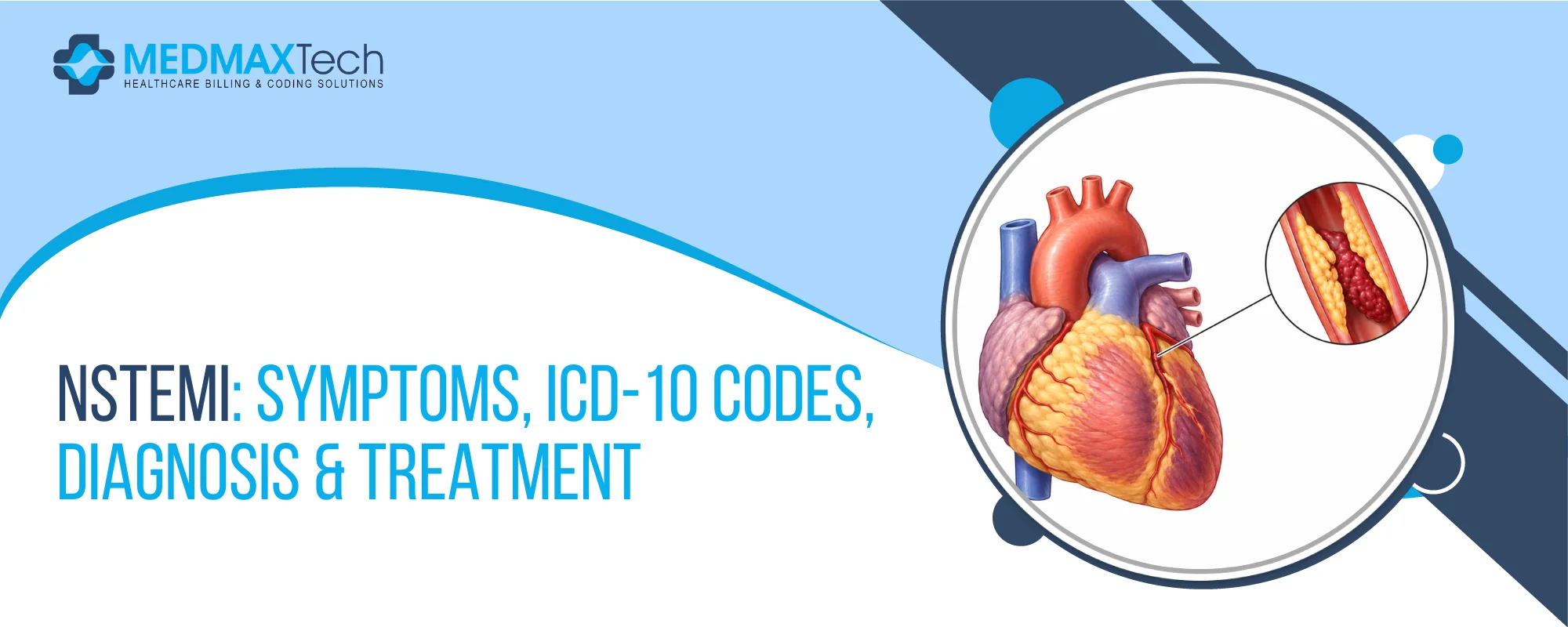
NSTEMI: Symptoms, ICD-10 Codes, Diagnosis & Treatment
NSTEMI is a type of heart attack that happens when a coronary artery is partly blocked. This blockage reduces the amount of blood flowing to your heart muscle and can quickly cause heart damage. An NSTEMI is a life-threatening medical emergency. You should get medical help immediately. Cardiologists will use procedures and medicines to restore blood flow to your heart.
What is NSTEMI?
A non-ST-segment elevation myocardial infarction (NSTEMI, or non-STEMI) is a common type of heart attack. It happens when a blood clot partly blocks blood flow through one of your coronary arteries. The name comes from the fact that an NSTEMI does not cause a specific electrical pattern called ST-segment elevation on an electrocardiogram (ECG/EKG) test. This is one of the main differences between an NSTEMI and a STEMI. Therefore, NSTEMI is a serious medical event which requires immediate attention and precise ICD-10 coding for healthcare practitioners.
Call 911 or your local emergency services number if you or someone with you has chest pain or discomfort or other heart attack symptoms. Waiting to get medical care can cause permanent heart damage or even death.
Symptoms and Causes
Symptoms of NSTEMI
NSTEMI symptoms are similar to the symptoms of any heart attack. They may include:
- Chest pain or discomfort
- Pain in your jaw, neck, shoulder, arm or back
- Shortness of breath
- Fatigue (extreme tiredness)
- Nausea or vomiting
- Anxiety
- Profuse sweating
- Dizziness or fainting
What causes a non-STEMI?
An NSTEMI usually happens when a blood clot forms on plaque inside a coronary artery. The clot causes a partial blockage and reduces blood flow to the heart. This can happen because of coronary artery disease (plaque buildup in the arteries that supply blood to your heart).
Plaque can build up inside your arteries over many years without causing noticeable symptoms. But sometimes the surface of the plaque becomes damaged or breaks open. When this happens, blood clots can form around the damaged area. These clots can quickly narrow the space available for blood to flow, sometimes within minutes to hours.
With an NSTEMI, some blood can still pass through the artery. But if the blood clot continues to grow, it can completely block the artery. When this happens, an NSTEMI can turn into a STEMI. This is an important reason why you need immediate treatment for any heart attack symptoms.
Risk factors
Several things can increase your risk of having an NSTEMI or another type of heart attack. These include:
- A history of early coronary artery disease in your biological family
- Smoking or using any tobacco products
- Chronic kidney disease
- High blood pressure
- A diet high in sodium, saturated fat and/or sugar
- Not getting enough physical activity
- Using addictive substances, such as amphetamines or cocaine
- Consuming too much alcohol
Complications of this condition
The reduced blood flow caused by an NSTEMI can damage your heart muscle. Part of the heart muscle may begin to die. Heart muscle cannot grow back or fully repair itself. Because of this, the damage can become permanent if blood flow is not restored quickly.
Possible complications of an NSTEMI include:
- Additional heart attacks
- Repeat episodes of reduced blood flow to your heart
- Heart failure
Without proper treatment, an NSTEMI can also be fatal.
Diagnosis and Tests
How doctors diagnose this condition
Cardiologists diagnose an NSTEMI by performing a physical exam and ordering different tests. They need to find out quickly whether you are having a heart attack. If you are, they also need to determine whether it is a STEMI or an NSTEMI. Knowing the exact type helps them choose the right treatment.
An EKG is one of the most important tests used to diagnose a heart attack. It records your heart’s electrical activity as waves on a graph. A heart attack can cause changes in these waves that healthcare providers can identify. One part of the wave is called the ST-segment. With a STEMI, this part is consistently higher than expected. An NSTEMI does not cause this same pattern.
Instead, possible signs of an NSTEMI on an EKG can include:
- Transient ST-segment elevation: The ST-segment becomes higher than normal, but only for a short time.
- ST-segment depression: The ST-segment moves below its normal baseline position.
- New T-wave inversion: A part of the EKG called the T-wave changes direction. For example, if it normally curves upward like a hill, it may now curve downward like a bowl.
Blood tests are also very important when diagnosing NSTEMIs and other heart attacks. Your Cardiologist will check for increased levels of a chemical called troponin. High troponin levels can be a sign that your heart muscle has been damaged.
You may also need imaging tests, such as an echocardiogram, heart CT scan or heart MRI. These tests create detailed images of your heart. Depending on the test, they can help providers find blockages and see whether your heart has been damaged.
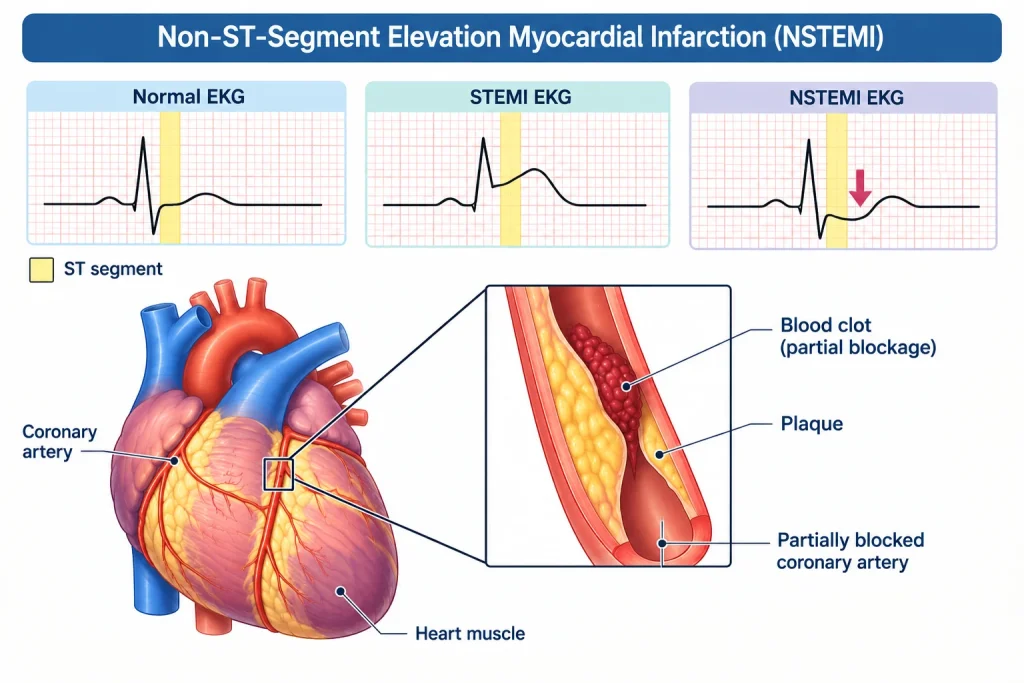
An NSTEMI doesn’t cause consistent ST-segment elevation on an EKG, but there may be other changes, like the ST-segment being too low (ST depression).
ICD-10 Coding for NSTEMI
Myocardial infarction (MI) documentation errors are no longer simply clinical inaccuracies. In today’s reimbursement environment, incorrectly classifying Type 1 MI, Type 2 MI, or demand ischemia, or using the wrong NSTEMI ICD-10 codes including Non-ST Elevation (NSTEMI) ICD-10 codes can directly affect DRG assignment, severity of illness, quality metrics, and the risk of audits.
NSTEMI, Type 1 vs Type 2 MI
NSTEMI ICD-10 Codes: Type 1 Myocardial Infarction Coding Essentials
Type 1 MI is a spontaneous myocardial infarction caused by coronary artery disease, typically due to plaque rupture or thrombosis.
Key Coding Rules:
- Acute Type 1 MI (STEMI or NSTEMI): Coded under I21
- Subsequent MI within 4 weeks of an initial MI: Coded under I22, with the original I21 code also reported
- Old or healed MI with no active treatment: Coded as I25.2
Accurate timing and provider documentation are essential to avoid misclassification.
NSTEMI ICD-10 Codes vs Type 2 MI: Understanding the Critical Differences
Type 2 MI occurs due to a supply demand mismatch, not acute plaque rupture. Common triggers include:
- Severe anemia
- Tachyarrhythmias
- Hypertensive emergencies
- Shock states
NSTEMI ICD-10 Coding:
Type 2 MI (initial or subsequent): I21.A1
This code applies only when myocardial necrosis is present, supported by biomarker elevation.
Demand Ischemia vs Type 2 MI: The Documentation Trap
This is where most revenue leakage occurs.
- Demand ischemia (I24.8)
Ischemia without myocardial necrosis
Cardiac biomarkers remain below the diagnostic threshold - Type 2 MI (I21.A1)
Supply demand mismatch with documented myocardial necrosis
When Cardiologists use “demand ischemia” to describe a true Type 2 MI, the case is often under-coded, directly affecting severity and reimbursement.
To discuss NSTEMI ICD-10 Coding optimization for your practice, schedule a consultation today at 586-436-3761 or info@medmaxtechnologies.com.
Why This Distinction Matters Financially
Incorrect MI classification can:
- Reduce DRG weight
- Misrepresent patient acuity
- Undermine value-based performance scores
- Trigger payer denials during audits
Accurate Cardiology Medical Billing documentation protects both clinical integrity and financial outcomes.
Post-Acute and Aftercare Coding
- MI-related encounters within 4 weeks of onset: Continue using appropriate I21 or I22 codes
- Encounters beyond 28 days: Use appropriate aftercare codes
- Old MI with no ongoing treatment: I25.2, if clearly documented
Timeline errors remain a common audit finding.
Code Summary for Practices and Hospitals
- Type 1 MI: I21 / I22
- Type 2 MI: I21.A1
- Demand ischemia: I24.8
The words used in Cardiologist documentation directly influence medical coding, DRGs, reimbursement, and compliance.
Management and Treatment
How is an NSTEMI treated?
Healthcare providers use procedures and medicines to improve blood flow through a blocked coronary artery. They also use medicines to help your heart work properly and reduce the risk of complications. Treatment for all heart attacks, including NSTEMIs, is time-sensitive. The sooner blood flow is restored, the better.
- Possible NSTEMI treatments include:
Percutaneous coronary intervention (PCI): This is a common treatment for heart attacks and can save lives. During the procedure, a healthcare provider uses a small balloon to open the blocked area of your artery. They will usually place a stent to help keep the artery open. - Coronary artery bypass grafting (CABG): This surgery may be needed when there are severe blockages. A surgeon creates a new path for blood to flow around the blocked or narrowed part of the artery.
- Dual antiplatelet therapy: You take aspirin together with another medicine. These medicines help prevent platelets from sticking together and forming blood clots. They can help stop existing clots from getting bigger and reduce the chance of new clots forming.
- Anticoagulants: These medicines also help lower your risk of developing blood clots.
ACE inhibitors: These medicines lower your blood pressure. You may be more likely to need them if you have heart failure, high blood pressure, kidney problems or diabetes. - Beta-blockers: These medicines slow your heart rate and reduce how hard your heart has to pump. This can help your heart work more efficiently when blood flow is reduced.
- Nitroglycerin: This medicine can help relieve chest pain.
- Statins: These medicines lower your blood cholesterol levels. This can help reduce plaque buildup in your arteries.
Recovery time
Your symptoms should begin to improve while you are receiving treatment. After a heart attack, many people feel tired or weak for several days. It is important to take things slowly and give your body time to recover.
Cardiac rehab can help you make your heart stronger, feel better sooner and improve your chances of living longer after a heart attack.
When should I see my healthcare provider?
Your cardiologist will tell you how often you need follow-up appointments. These visits are an important part of your recovery and long-term heart health. During these appointments, your provider can check how well your heart is working and ask about any symptoms or concerns you may have.
Contact your doctor if you develop new or changing symptoms, experience side effects from your medicines or have questions about your treatment plan.
If chest discomfort or other NSTEMI symptoms come back, call 911 or your local emergency services number immediately.
Outlook / Prognosis
What can I expect if I have this condition?
The outlook for an NSTEMI can be different for each person. It depends on several factors, including how much damage has occurred to your heart muscle. Having any type of heart attack also increases your risk of having another heart attack in the future.
Follow-up care and preventive steps are very important. This includes taking your prescribed medicines as directed and going to all of your follow-up appointments. Your cardiologist can explain your individual outlook and tell you what you can do to protect your heart and reduce your future risk.
A Note for You:
Heart attack symptoms can be frightening and confusing. The good news is that doctors and other healthcare providers now know much more about diagnosing and treating heart attacks than they did in the past. Medical care continues to improve, which means treatment and outcomes can continue to get better.
If you’ve had an NSTEMI, work closely with your doctor and follow your treatment plan. Take your medicines as prescribed and attend your follow-up appointments. Ask questions whenever something is unclear, and remember that your healthcare provider is there to help, guide and support you.
Doing Everything Right But Still Not Getting Paid….
Sometimes the problem isn’t your team, it’s the system. Our clients recover tens of thousands simply by letting us take a look.
- No more resubmitting again and again 97% Claim Approval Rate
- No delays, no backlog, just clean submissions 24-hour Claim Turnaround
- 100% HIPAA-compliant, audit-proof systems HIPAA Compliance
- Track every dollar and denial in real time Weekly, Monthly Reports



Jessica Collins
Jessica Collins is a Medical Coding Expert with 9+ years of experience in ICD-10, CPT coding, clinical documentation, and revenue cycle management. She shares practical insights to improve coding accuracy, billing efficiency, and healthcare compliance.