





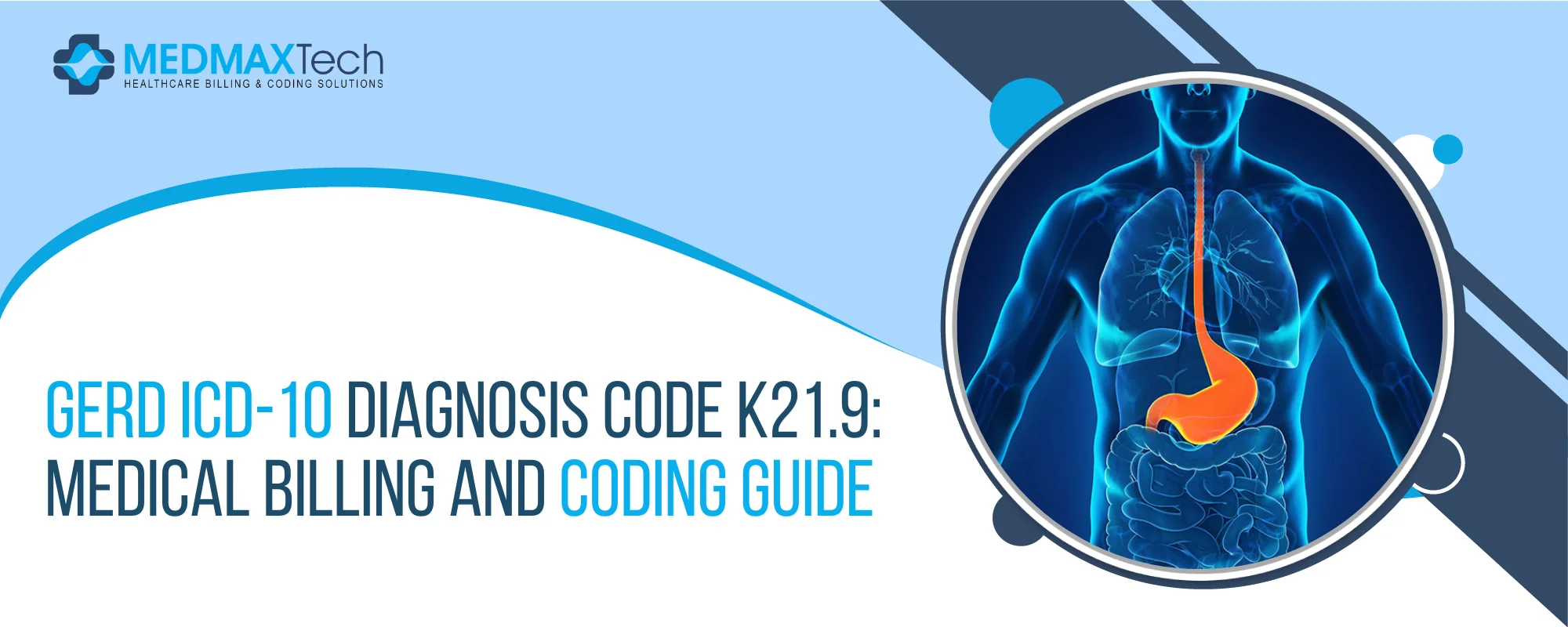
GERD ICD-10 Diagnosis Code K21.9: Medical Billing and Coding Guide
Gastroesophageal Reflux Disease (GERD) is one of the most commonly diagnosed digestive conditions, especially in gastroenterology practices. As more patients seek treatment for acid reflux and indigestion, accurate medical coding becomes more important than ever. Proper coding helps ensure correct documentation, timely reimbursement, and compliance with coding guidelines. Healthcare providers use ICD-10-CM diagnosis code K21.9 to report GERD cases that occur without esophagitis.
Using the wrong diagnosis code can lead to claim denials, delayed payments, and compliance issues. Professional medical coding and billing services from Medmax Technologies LLC help healthcare organizations improve coding accuracy and maximize reimbursement.

What is ICD-10-CM Code K21.9?
- ICD-10-CM Code: K21.9
- Description: Gastro-esophageal reflux disease without esophagitis
- Category: Diseases of the digestive system
Healthcare providers use this code when a patient is diagnosed with GERD, but there is no evidence of esophagitis or inflammation in the esophagus. It is also appropriate when the provider does not document any related complications affecting the esophagus.
Common Symptoms Related to K21.9 Documentation
Before assigning K21.9, medical coders should make sure the physician’s documentation clearly supports the GERD diagnosis. Common symptoms include:
- Persistent heartburn
- Acid regurgitation
- Chest discomfort caused by acid reflux
- Chronic cough related to reflux
- Mild difficulty swallowing
- Sour or bitter taste in the mouth
If tests such as endoscopy or pH monitoring confirm that the patient has GERD but do not show esophagitis, then K21.9 is the correct diagnosis code.
When Should You Use ICD-10-CM K21.9?
Use K21.9 only when:
- A physician has confirmed the diagnosis of GERD.
- There is no evidence of esophagitis.
- The provider does not document any complications involving the esophagus.
- The patient’s symptoms match GERD, but there is no clinical evidence of inflammation.
What if Esophagitis is Present?
If the medical record shows that the patient has GERD with esophagitis, then K21.0 (Gastro-esophageal reflux disease with esophagitis) should be reported instead of K21.9.
| GERD Type | ICD-10-CM Code | Description |
|---|---|---|
| Without esophagitis | K21.9 | GERD without esophagitis |
| With esophagitis | K21.0 | GERD with esophagitis |
Coding Tips for Accurate Reimbursement
To reduce coding errors and prevent claim denials, follow these best practices:
- Verify the GERD diagnosis in the physician’s documentation.
- Review endoscopy and imaging reports before assigning the code.
- Do not use K21.9 if esophagitis or Barrett’s esophagus is documented.
- Check for related conditions such as hiatal hernia (K44.9), which may require an additional diagnosis code.
- If only symptoms such as heartburn are documented without a confirmed GERD diagnosis, use R12 (Heartburn) instead of K21.9.
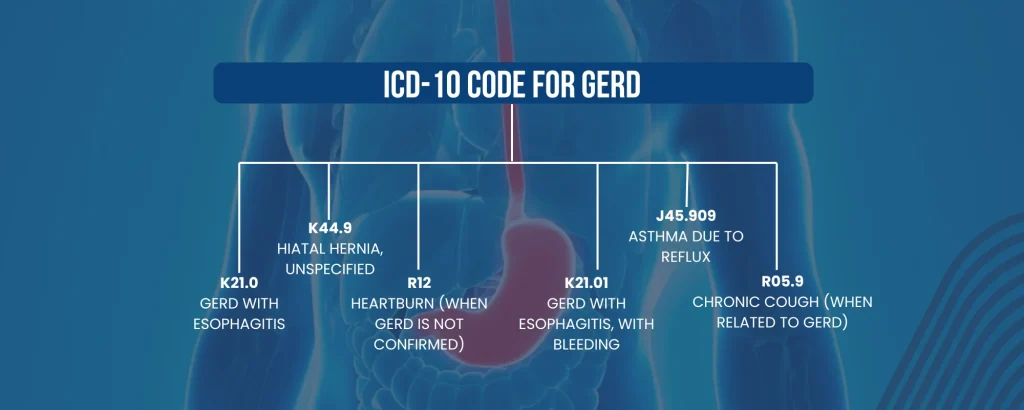
K21.9 Related Codes
| ICD Code | Description |
|---|---|
| K21.0 | GERD with esophagitis |
| R12 | Heartburn (when GERD is not confirmed) |
| K44.9 | Hiatal hernia, unspecified |
| J45.909 | Asthma due to reflux |
| R05.9 | Chronic cough (when related to GERD) |
Why Accurate Coding for GERD Matters
Using the correct diagnosis code is important for both clinical documentation and revenue cycle management. Incorrect or incomplete coding can result in:
- Claim denials because of missing documentation
- Incorrect reimbursement for healthcare services
- Compliance concerns during payer audits
- Higher accounts receivable (A/R) balances due to payment delays
Correct use of ICD-10-CM K21.9 helps healthcare providers submit clean claims, receive proper reimbursement, and maintain coding compliance.
Doing Everything Right But Still Not Getting Paid….
Sometimes the problem isn’t your team—it’s the system. Our clients recover tens of thousands simply by letting us take a look.
- 97% Claim Approval Rate
- 24-hour Claim Turnaround
- 100% HIPAA-compliant
- Weekly, Monthly Reports
Billing & Documentation Guidelines
The following documentation should be available to support K21.9:
- Physician-confirmed diagnosis of GERD
- Documentation showing no esophagitis on EGD or endoscopy
- Clinical notes describing reflux-related symptoms
- Treatment plan, including medications such as proton pump inhibitors (PPIs), antacids, or H2 blockers
Example
“Patient reports frequent heartburn and an acidic taste in the mouth. Endoscopy shows no inflammation of the esophagus. Diagnosed with GERD without esophagitis. Started on proton pump inhibitor therapy.”
Appropriate code: K21.9
Common Denial Reasons Related to K21.9
| Denial Reason | Cause |
|---|---|
| Lack of supporting documentation | Physician did not confirm the GERD diagnosis |
| Incorrect use of K21.9 | Esophagitis was documented, but K21.9 was submitted |
| Only symptoms documented | Provider recorded symptoms without confirming GERD |
A detailed coding review can help identify these issues before claims are submitted and reduce the risk of denials.
Medmax Technologies LLC Ensures Accurate ICD-10 Coding for GERD
Medmax Technologies LLC supports healthcare providers with accurate GERD coding by offering:
- HIPAA-certified medical coders
- Compliance with current payer guidelines
- Clinical Documentation Improvement (CDI) support
- Dual coding audits to improve accuracy
- Specialty-focused coding expertise for gastroenterology and internal medicine
Our experienced coders help you:
- Select the most accurate GERD diagnosis code
- Improve reimbursement rates
- Reduce claim denials
- Stay compliant with CMS coding updates
- Increase charge capture accuracy
Benefits of Outsourcing ICD-10-CM Coding to Medmax Technologies LLC
Choosing Medmax Technologies LLC for medical coding services provides several advantages, including:
- 98%+ coding accuracy
- 95% claims rate
- 30–35% increase in collections
- Fewer billing errors
- Lower compliance risk
- Better revenue performance
- Reduced administrative workload
- Scalable support for growing patient volumes
Conclusion
ICD-10-CM K21.9 is the correct diagnosis code for GERD without esophagitis. Using this code correctly improves clinical documentation, reduces claim denials, supports compliance, and helps healthcare providers receive accurate reimbursement. By following proper coding guidelines and partnering with experienced coding professionals like Medmax Technologies LLC, healthcare organizations can improve coding quality, strengthen revenue cycle performance, and reduce costly billing errors.



Jessica Collins
Jessica Collins is a Medical Coding Expert with 9+ years of experience in ICD-10, CPT coding, clinical documentation, and revenue cycle management. She shares practical insights to improve coding accuracy, billing efficiency, and healthcare compliance.