






Medmax technologies Logo
While you focus on patient care, know that Medmax handles your complicated operational and analytical tasks. Our full range of services lets you take a sigh of relief!
Mon - Fri: 10:00AM - 10:00PM Sat - Sun: Closed
sales@medmaxtechnologies.com

Related Posts

Expand Practice Nationwide - Get Medical License in All 50 States With Medmax!
888-402-2631
info@medmaxtechnologies.com
Title Image

Right Shoulder Pain ICD-10 Code : M25.511

Home  /  ICD Codes   /  Right Shoulder Pain ICD-10 Code : M25.511
pain in right shoulder icd 10

Right Shoulder Pain ICD-10 Code : M25.511

The ICD-10 coding system plays a key role in documenting medical conditions, making diagnoses, and managing billing in today’s healthcare system. It helps healthcare providers keep accurate medical records and supports smooth insurance claim processing. When it comes to musculoskeletal conditions, using the correct ICD-10 code is important for proper treatment, documentation, and reimbursement.
Right Shoulder Pain ICD-10 Code M25.511 is the official medical code used to document and bill for pain that occurs specifically in the right shoulder joint. This code clearly identifies pain in the right shoulder instead of the left shoulder or both shoulders. It improves clinical documentation, reduces claim denials, and helps healthcare providers maintain accurate patient records. Using M25.511 also allows physicians to record right shoulder pain consistently across healthcare systems. This blog explains how to correctly diagnose and use the right shoulder pain ICD Code M25.511, which is commonly used by a medical coding company in USA.

Why ICD-10 Coding Matters in Right Shoulder Pain

Using the correct ICD-10 code for right shoulder pain is essential for accurate diagnosis, treatment, and billing. The ICD-10 code M25.511 specifically identifies pain in the right shoulder, making documentation more accurate and complete. Standardized coding improves consistency across electronic health records (EHRs) and healthcare systems, helping providers coordinate patient care while reducing documentation errors.
Accurate coding benefits healthcare providers, medical coders, patients, and researchers. It supports proper diagnosis, ensures coding compliance, improves reimbursement, and provides reliable healthcare data that can be used to study treatment outcomes and improve patient care.
For healthcare providers who want to maintain accurate coding and streamline reimbursement, reliable medical billing services in USA can help improve documentation compliance and support efficient claims processing without disrupting existing clinical workflows.

Understanding ICD-10 Code M25.511

ICD-10 code M25.511 is the official code used to identify pain in the right shoulder. It clearly documents the affected side, making it useful for both clinical records and insurance billing. This is a billable code under the M25 category and belongs to Chapter 13, which covers diseases of the musculoskeletal system and connective tissue (M00–M99).
According to ICD 10 cmtool, external cause codes may also be reported with M25.511 when the underlying reason for the musculoskeletal condition is known.

ICD-10 Description

The official diagnosis code for right shoulder pain is ICD-10 code M25.511. It is used when a patient reports pain in the right shoulder, but no more specific medical condition has been diagnosed during the visit.

Code Category

The code M25.511 belongs to the broader M25 category, which covers other joint disorders that are not classified elsewhere. This category is commonly used for joint-related symptoms such as pain, stiffness, and instability when no confirmed structural diagnosis has been established.

Billable Status and Coding Complexity

M25.511 is a billable and specific ICD-10 code, which means it can be submitted on insurance claims for reimbursement. It is preferred over icd 10 right shoulder pain unspecified whenever documentation clearly identifies the pain in the right shoulder. Using the correct icd 10 code right shoulder pain improves coding accuracy, supports proper reimbursement, and helps reduce claim denials across healthcare systems.

When M25.511 Should Be Assigned

The ICD-10 code for pain in the right shoulder should be assigned when right shoulder pain is the patient’s primary complaint and there is no confirmed diagnosis explaining the cause. If a specific condition such as right shoulder bursitis M75.51 or right clavicle pain such as ICD 10 code for right clavicle pain has not yet been diagnosed, M25.511 is the appropriate code to document the symptom while additional evaluation is being completed.

Usage of M25.511 vs. Other Shoulder ICD-10 Codes

The ICD-10 code M25.511 is used for common icd right shoulder pain when no specific shoulder condition has been identified during the patient’s visit. Choosing the correct code depends on several factors, including laterality, clinical findings, and whether a more specific diagnosis has been confirmed.

General Shoulder Pain vs. Diagnosed Conditions

The code M25.511 should be used when a patient presents with icd 10 code right shoulder pain but no underlying condition has been confirmed. Once a specific diagnosis is established, such as right shoulder bursitis M75.51 or another diagnosed shoulder disorder, the general ICD-10 pain in the right shoulder code should be replaced with the more specific diagnosis code to reflect the patient’s actual condition.

Primary vs. Secondary Diagnosis Use

When right shoulder pain is the main reason for the patient’s visit, M25.511 can be reported as the primary diagnosis. If the shoulder pain is related to another disease, injury, or medical procedure, it may be reported as a secondary diagnosis. Correctly assigning the diagnosis code for shoulder pain helps ensure accurate documentation and proper reimbursement.

Documentation for Proper Selection

Choosing the correct code depends on complete clinical documentation. Medical records should clearly describe the location of the pain, laterality, duration, severity, and any related clinical findings. Well-documented notes help medical coders select the correct ICD-10 code for pain in the right shoulder or update the diagnosis to a more specific code when one becomes available.
The same documentation-based approach is also important when coding related conditions, such as ICD-10 Code for Abnormal Weight Gain, helping improve coding accuracy, maintain compliance, and increase claim acceptance.

Clinical Presentation of ICD Right Shoulder Pain M25.511

he right shoulder pain icd 10 code is commonly used when a patient experiences pain, stiffness, aching, severe discomfort, or limited movement in the right shoulder. The pain often becomes worse during activities such as lifting objects, reaching overhead, or performing repetitive arm movements.
Many patients also have difficulty carrying out daily activities, including getting dressed, sleeping on the affected side, or completing routine tasks at home or work. In many cases, these general symptoms are documented using the M25.511 right shoulder pain ICD-10 code.
However, certain warning signs such as numbness, recent trauma, severe weakness, fever, or long-lasting pain may indicate a more serious condition. In these situations, a more specific diagnosis of icd right shoulder pain, such as a clavicle injury or right shoulder bursitis M75.51, should be reported instead of using a general icd 10 pain right shoulder code.

Differential Diagnosis: Selecting the Correct ICD-10 Code M25.511

Accurate coding requires healthcare providers to distinguish general right shoulder pain from specific shoulder conditions that have their own ICD-10 codes. The right shoulder pain ICD-10 code M25.511 should only be used when no confirmed structural condition has been diagnosed. Once the exact cause of the pain is identified, a more specific ICD-10 code should replace M25.511.

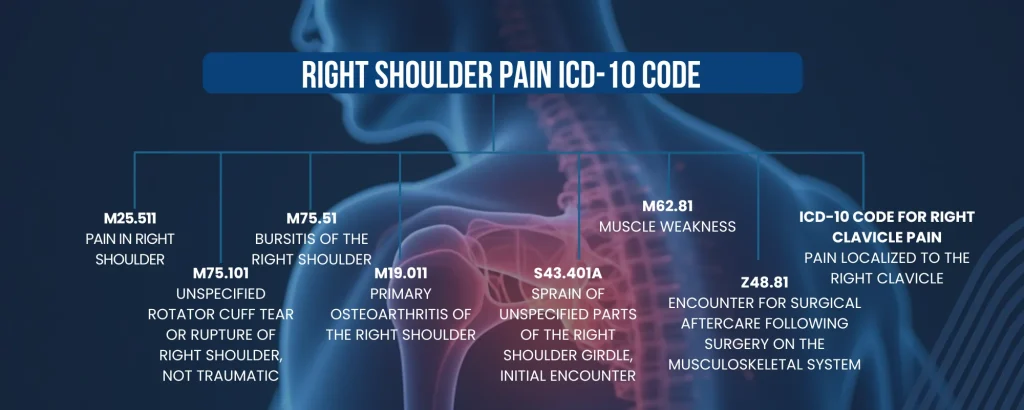
Below are some commonly related ICD-10 codes.

General Right Shoulder Pain

  • M25.511 is used for pain in the right shoulder.
  • It should be assigned when no specific structural condition has been confirmed.
  • This is appropriate for initial or nonspecific presentations.

Rotator Cuff Disorders

  • M75.101 represents an unspecified rotator cuff tear or rupture of the right shoulder that is not identified as traumatic.
  • This code should be used when clinical findings or imaging confirm a rotator cuff tear.

Bursitis

  • M75.51 is used for right shoulder bursitis.
  • It applies when inflammation of the shoulder bursa has been clearly diagnosed.
  • This code provides a more accurate diagnosis than the general ICD 10 pain in the right shoulder code.

Osteoarthritis

  • M19.011 identifies primary osteoarthritis of the right shoulder.
  • It should be reported when degenerative joint disease is confirmed as the cause of shoulder pain.

Shoulder Sprain or Strain

  • S43.401A represents a sprain of an unspecified part of the right shoulder girdle during the initial encounter.
  • This code is appropriate for pain caused by an acute injury rather than chronic or nonspecific shoulder pain.
right shoulder pain icd 10

ICD-10 Codes for Right Shoulder Pain

ICD-10 CodeDescriptionCauses and SymptomsCoding and Clinical Details
M25.511Pain in right shoulderGeneral shoulder pain, aching, stiffness, limited range of motion, and discomfort during lifting or overhead activities.A billable ICD-10 code used when no specific diagnosis has been confirmed. It identifies pain in the right shoulder and is commonly used during the initial evaluation.
M75.101Unspecified rotator cuff tear or rupture of right shoulder, not traumaticShoulder weakness, pain while raising the arm, night pain, and reduced shoulder strength.Use this code only when a rotator cuff tear has been confirmed through a clinical examination or imaging studies. It is more specific than general shoulder pain codes.
M75.51Bursitis of the right shoulderShoulder inflammation, swelling, tenderness, and pain during movement or when pressure is applied.Report this code when right shoulder bursitis has been confirmed. It should replace M25.511 once the diagnosis is established.
M19.011Primary osteoarthritis of the right shoulderLong-term shoulder pain, joint stiffness, reduced mobility, and crepitus.This code is used for confirmed degenerative joint disease. Clinical evaluation or imaging should support the diagnosis before assigning the code.
S43.401ASprain of unspecified parts of the right shoulder girdle, initial encounterSudden shoulder pain after trauma, swelling, bruising, and limited movement.An injury-specific code used for acute shoulder sprains or traumatic injuries. It should not be used for chronic or nonspecific shoulder pain.
M62.81Muscle weaknessReduced muscle strength, difficulty lifting objects, and limited shoulder function.Use this code when muscle weakness is the primary diagnosis. It may also be reported with pain codes if both conditions are clearly documented.
Z48.81Encounter for surgical aftercare following surgery on the musculoskeletal systemPost-surgical discomfort, healing-related symptoms, and routine follow-up care.This code is intended for postoperative aftercare rather than active disease or injury. It should only be used during follow-up after musculoskeletal surgery.
ICD-10 code for right clavicle painPain localized to the right claviclePain around the collarbone, tenderness, swelling, or discomfort caused by trauma, overuse, or injury.Use a clavicle-specific diagnosis code when the source of pain is the clavicle instead of the shoulder joint to ensure accurate documentation and billing.

Causes and Risk Factors of Right Shoulder Pain

Diagnosing right shoulder pain M25.511 begins with a detailed medical history and physical examination. Healthcare providers evaluate the location of the pain, its severity, how long it has been present, and how it affects the patient’s daily activities.
A physical examination is usually followed by imaging studies when needed. Diagnostic tests such as X-rays, MRI scans, or ultrasound help identify structural problems involving bones, muscles, tendons, ligaments, or other soft tissues.
Healthcare providers also perform functional assessments and range-of-motion tests to evaluate shoulder movement and determine how much the condition limits normal activities.
If testing confirms a specific condition such as a clavicle injury, rotator cuff tear, or right shoulder bursitis M75.51, the diagnosis should be updated from M25.511 to the appropriate ICD-10 code for right shoulder pain or another confirmed diagnosis. Using the most accurate code supports proper clinical documentation, improves coding accuracy, and helps ensure correct insurance reimbursement.
A similar approach is followed when coding related musculoskeletal conditions. For example, guidance on ICD-10 coding for left leg pain also emphasizes selecting the most accurate diagnosis code to improve documentation quality and streamline billing.

Use of M25.511 Across Medical Specialties

The right shoulder pain ICD-10 code M25.511 is used by many healthcare specialties to document nonspecific right shoulder pain. It helps providers maintain consistent medical records and supports better communication between different healthcare teams.
In primary care, M25.511 is commonly used to record a patient’s initial complaint before a specific diagnosis is confirmed. It also helps physicians monitor symptoms and coordinate referrals when needed.
In physical therapy, the code is used to evaluate shoulder function, track recovery, and develop personalized rehabilitation plans. Therapists use it to monitor improvements in strength, flexibility, and range of motion throughout treatment.
In geriatrics, M25.511 helps document shoulder pain related to age-related musculoskeletal conditions and reduced mobility. Older adults often experience chronic shoulder pain due to joint degeneration or other underlying conditions.
In neurology, providers may use M25.511 when evaluating shoulder pain that could be associated with nerve-related disorders. Additional testing may be required to determine whether the pain is neurological or musculoskeletal in origin.
The code is also used in oncology to document shoulder pain that develops as a symptom of cancer or as a side effect of treatment. Using M25.511 promotes consistent documentation and improves communication between healthcare providers managing the patient’s care.

ICD-10 Coding M25.511: Management, Practices and Strategies

Accurate documentation and proper treatment planning are essential when using right shoulder pain M25.511. Correct coding depends on documenting laterality, pain severity, duration, associated symptoms, and updating the diagnosis whenever a more specific condition is confirmed.
Treatment usually begins with conservative care before moving to advanced or surgical options if necessary. Proper documentation supports both effective patient care and accurate insurance reimbursement.
The following best practices can help improve coding accuracy and patient management:

  • Always document the exact location, severity, and duration of right shoulder pain.
  • Record laterality by using the right shoulder code instead of unspecified shoulder pain codes.
  • Update the diagnosis to more specific ICD-10 codes, such as M75.51 for right shoulder bursitis, whenever the condition is confirmed.
  • Begin treatment with activity modification, rest, and appropriate pain management when suitable.
  • Recommend physical therapy to improve shoulder strength, flexibility, and range of motion.
  • Consider corticosteroid injections for patients with ongoing pain that does not respond to conservative treatment.
  • Refer patients to orthopedic specialists or pain management specialists when symptoms continue or structural injuries are identified.

Comorbidities and Additional Coding Considerations

The right shoulder pain ICD-10 code M25.511 may also be reported as a secondary diagnosis when shoulder pain occurs along with another primary medical condition. These conditions may include osteoarthritis, rotator cuff disorders, systemic musculoskeletal diseases, or other underlying health problems.
Some patients may have additional medical conditions that require separate ICD-10 codes. These may include:

  • Rheumatoid arthritis
    Diabetes
  • Cervical spine disorders
  • Other musculoskeletal diseases affecting shoulder function

Accurate and complete coding of all documented conditions improves clinical documentation, supports medical necessity, and helps providers receive appropriate reimbursement for the services they deliver.

When M25.511 Should Not Be Applied

The right shoulder pain ICD-10 code M25.511 should not be used when the exact cause of shoulder pain has already been identified. In these cases, providers should assign the ICD-10 code that specifically describes the diagnosed condition.
For example:

  • Use M19.011 for primary osteoarthritis of the right shoulder when degenerative joint disease has been confirmed.
  • Use the appropriate neurological ICD-10 code when shoulder pain is caused by nerve disorders or radiculopathy instead of using M25.511.
  • When muscle weakness is the primary diagnosis, codes such as M62.81 should be reported instead of a general shoulder pain code.
  • For shoulder pain following surgery or trauma, providers should use procedure follow-up codes or injury-specific codes such as S43.401A for shoulder sprain or Z48.81 for postoperative care when appropriate.

Selecting the correct ICD-10 code ensures accurate medical documentation, supports insurance billing, and provides greater clinical clarity for icd 10 right shoulder pain.

Common Coding Errors and Insurance Denials

Insurance claim denials related to the right shoulder pain icd 10 code often happen because of incomplete documentation, incorrect diagnosis coding, or mismatches between the diagnosis and the procedures performed. Proper documentation and accurate coding are essential for reducing claim rejections and improving reimbursement. Denial management services can also help providers identify and resolve common coding mistakes before claims are submitted.
Below are some of the most common coding errors that should be avoided:

  • Using M25.511 without enough clinical evidence, such as physical examination findings or diagnostic imaging.
  • Failing to report the confirmed underlying condition, such as osteoarthritis (M19.011), rotator cuff tear (M75.101), or bursitis (M75.51), when these diagnoses have been established.
  • Using ICD-10 diagnosis codes that do not match the CPT procedure codes billed for treatment.
  • Continuing to use a general pain code after a more specific diagnosis has been confirmed.
  • Missing documentation that supports the medical necessity of procedures, imaging studies, or treatment.
  • Providing incomplete clinical notes that do not describe symptoms, functional limitations, or the reason for treatment.
  • Not updating the diagnosis code as the patient’s condition changes over time.

Avoiding these mistakes helps improve coding accuracy, reduces insurance denials, and speeds up reimbursement.

Compliance, Reimbursement, and Legal Considerations: ICD-10 Code M25.511

Using the M25.511 right shoulder pain ICD-10 code correctly is essential for accurate reimbursement, faster claim processing, and regulatory compliance. Proper documentation supports Medicare and HIPAA requirements while reducing the risk of audits, penalties, and legal complications.
Healthcare providers should ensure that every diagnosis is supported by complete clinical documentation and medical necessity. Accurate coding not only improves reimbursement but also protects providers from compliance issues.
Additional guidance on lower back pain ICD-10 coding, from unspecified to chronic conditions, also demonstrates how proper code selection supports accurate reporting and successful reimbursement.
The following compliance and legal considerations are important when using M25.511:

  • Supports accurate claim submission and faster reimbursement.
  • Helps maintain compliance with payer requirements, including HIPAA and Medicare regulations.
  • Reduces claim denials caused by vague, incorrect, or unsupported diagnosis codes.
  • Prevents miscoding and upcoding that may result in audits, penalties, or financial consequences.
  • Protects healthcare providers from legal and compliance risks.
  • Strengthens documentation of medical necessity for shoulder pain evaluation and treatment.
  • Improves overall coding quality through regular documentation reviews and coding audits.

Patient Impact and Future Outlook for Shoulder Pain Coding

The ICD-10 code M25.511 for right shoulder pain represents more than a billing code. Right shoulder pain can significantly affect a patient’s quality of life by limiting movement, reducing independence, and creating emotional and financial challenges. Early diagnosis, appropriate treatment, and accurate documentation all contribute to better patient outcomes.
Patients with right shoulder pain may experience:

  • Difficulty performing daily activities such as dressing, lifting objects, reaching overhead, or carrying groceries.
  • Chronic pain that can lead to stress, frustration, irritability, anxiety, and sleep disturbances.
  • Increased financial burden due to repeated doctor visits, diagnostic tests, medications, and rehabilitation services.
  • Better recovery when they receive individualized treatment plans and timely medical care.
  • Reduced discomfort by improving posture, modifying daily activities, and performing recommended stretching and strengthening exercises.
  • Safer and more effective pain control through appropriate medication management under medical supervision.

Looking ahead, healthcare is gradually preparing for the transition to ICD-11, which will introduce more detailed and standardized coding for shoulder pain and other musculoskeletal conditions.

Future improvements include:

  • More specific classification based on pain type, underlying cause, severity, and laterality.
  • Better clinical documentation and improved communication across healthcare systems.
  • Enhanced coding accuracy that supports patient care, research, and reimbursement.
  • Successful ICD-11 implementation through staff education, updated Electronic Health Records (EHRs), and ongoing coding training.

How Medmax Technologies LLC Supports Accurate Right Shoulder Pain Coding

Accurate documentation and coding of right shoulder pain (M25.511) are essential for maintaining clinical accuracy, ensuring regulatory compliance, and maximizing reimbursement. Correct ICD-10 coding helps healthcare providers reduce claim denials, improve documentation quality, and support better patient care.
Medmax Technologies LLC assists healthcare organizations by ensuring accurate ICD-10 coding, verifying laterality, documenting related medical conditions, and improving the overall claims submission process. Their experienced coding professionals help providers maintain compliance while reducing administrative workload.
By focusing on coding accuracy, denial prevention, reimbursement optimization, and documentation quality, Medmax Technologies LLC enables healthcare providers to spend more time caring for patients while confidently managing every aspect of right shoulder pain ICD-10 code reporting.

FAQs

What is the difference between M25.511 and a rotator cuff tear?

M25.511 is used to report general right shoulder pain when no specific underlying condition has been confirmed. A rotator cuff tear is a diagnosed structural injury and should be coded with a more specific ICD-10 code, such as M75.101, once the diagnosis is confirmed through a clinical examination or imaging.

Is M25.511 covered by Medicare?

Yes. M25.511 is a billable ICD-10 code and is generally covered by Medicare when it is medically necessary and supported by complete clinical documentation. It can be reported as either a primary or secondary diagnosis, depending on the patient’s condition.

Should M25.511 be used for acute injuries?

No. M25.511 should not be used for acute traumatic shoulder injuries. When the pain is caused by trauma, sprains, fractures, or other specific injuries, the appropriate injury-related ICD-10 code should be assigned instead.

Can M25.511 be used alongside other shoulder diagnoses?

Yes. M25.511 may be reported as a secondary diagnosis when right shoulder pain exists along with a confirmed condition, such as right shoulder bursitis (M75.51) or primary osteoarthritis of the right shoulder (M19.011), if the documentation supports reporting both conditions.

author avatar
Jessica Collins Healthcare Writer & Certified Professional Coder
Jessica Collins is a Medical Coding Expert with 9+ years of experience in ICD-10, CPT coding, clinical documentation, and revenue cycle management. She shares practical insights to improve coding accuracy, billing efficiency, and healthcare compliance.

Jessica Collins is a Medical Coding Expert with 9+ years of experience in ICD-10, CPT coding, clinical documentation, and revenue cycle management. She shares practical insights to improve coding accuracy, billing efficiency, and healthcare compliance.

No Comments
Post a Comment
Name
E-mail
Website